
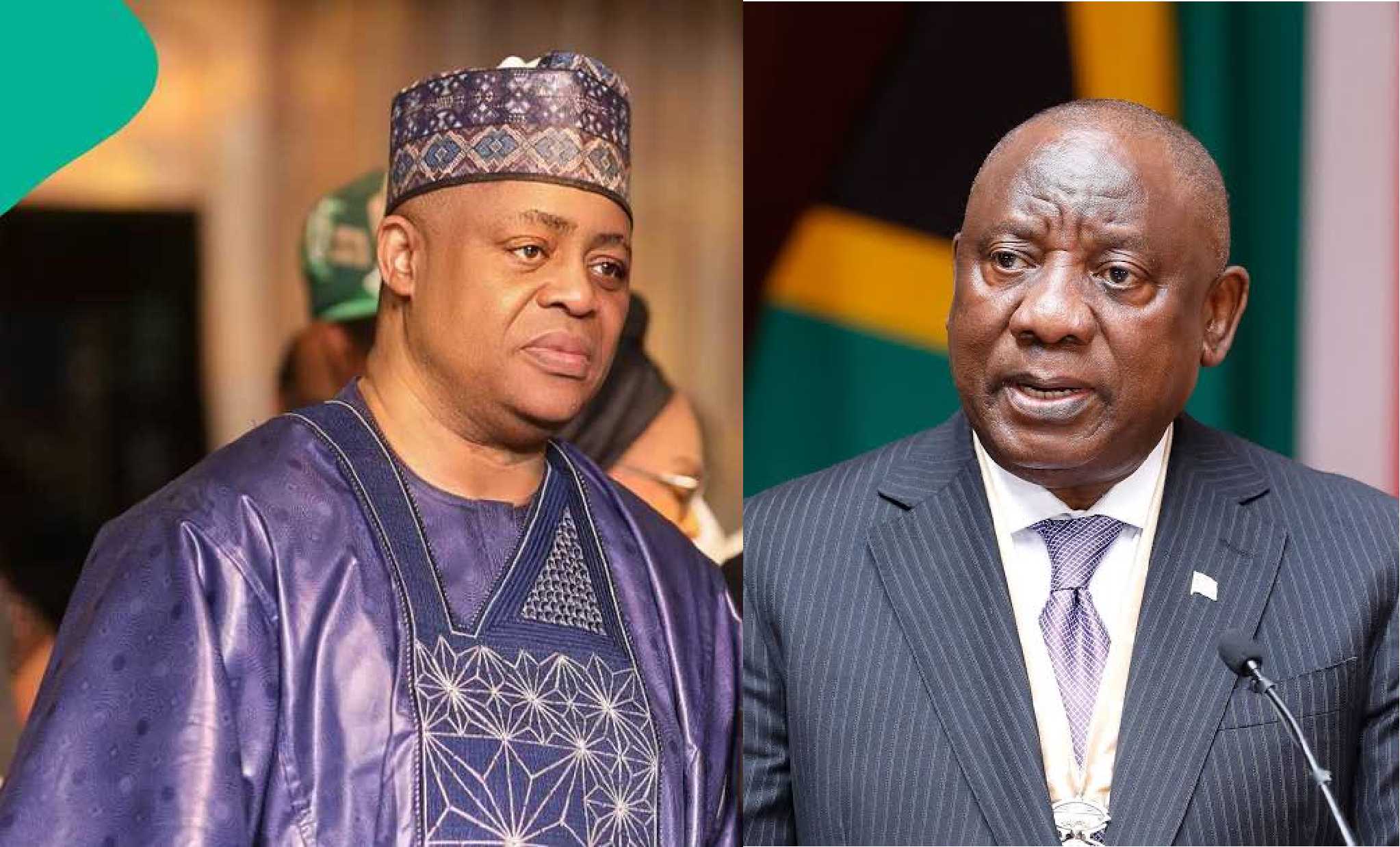
South Africa has formally raised concerns with Nigerian High Commissioner Femi Fani-Kayode over his social media remarks following a diplomatic credentials ceremony.
South Africa has formally cautioned Nigeria’s High Commissioner to the country, Femi Fani-Kayode, over his conduct and social media remarks following a diplomatic controversy surrounding the presentation of his credentials to President Cyril Ramaphosa.
The South African Department of International Relations and Cooperation (DIRCO) disclosed that its Director-General, Zane Dangor, met with the Nigerian envoy on Tuesday, November 17, 2026, to formally convey Pretoria’s concerns about the events that followed the diplomatic ceremony and Fani-Kayode’s subsequent public comments.
During the meeting, South African officials reminded the Nigerian diplomat of the rules governing diplomatic conduct under the 1961 Vienna Convention on Diplomatic Relations, particularly Article 41, which requires diplomatic agents to conduct official business with their host countries through established diplomatic channels.
The development follows a disagreement that erupted after Fani-Kayode accused South African officials of deliberately excluding his introduction and speech from the livestream of a credentials ceremony attended by 15 ambassadors and high commissioners.
His complaint triggered a public exchange involving the Nigerian High Commission, South African presidential spokesperson Vincent Magwenya and other government officials.
The latest meeting represents a formal diplomatic response from Pretoria, although South Africa has reaffirmed its commitment to maintaining cordial relations and strengthening its strategic partnership with Nigeria.
South Africa Raises Concerns Over Fani-Kayode’s Conduct
According to DIRCO’s statement, Dangor met Fani-Kayode to discuss the controversy surrounding the presentation of his Letters of Credence to President Ramaphosa and the comments he subsequently made on social media.
The South African official reportedly expressed concern over how the Nigerian envoy handled the disagreement, particularly the decision to make his grievances public.
DIRCO said the meeting was intended to reinforce the importance of established diplomatic procedures and ensure that official disagreements between the two countries are addressed through the appropriate institutions.
The department stated:
“During the meeting, the Director-General conveyed South Africa’s concern regarding events that transpired following the presentation of the High Commissioner’s Letters of Credence to His Excellency President Cyril Ramaphosa, as well as subsequent remarks made on social media.”
Dangor also reaffirmed the importance of preserving the longstanding relationship between Nigeria and South Africa, describing the partnership as one founded on mutual respect, friendship and cooperation.
The meeting did not amount to an announcement that Fani-Kayode had been removed from his diplomatic position. Rather, it was a formal expression of South Africa’s displeasure with the handling of the controversy.
What Happened at Ramaphosa’s Diplomatic Credentials Ceremony?
The controversy began on Friday, November 13, 2026, when President Cyril Ramaphosa received the Letters of Credence of 15 heads of mission-designate at the Presidential Guest House in Pretoria.
The ceremony formally marked the commencement or recognition of the diplomats’ assignments in South Africa.
Nigeria was represented by Femi Fani-Kayode, whose presentation of credentials was an important step in his diplomatic assignment as the country’s High Commissioner to South Africa.
Following the event, Fani-Kayode took to his X account to complain that the Nigerian delegation had been excluded from the presidential livestream.
He alleged that all 15 ambassadors and high commissioners were formally introduced and given opportunities to deliver speeches, but that the South African Presidency failed to broadcast his introduction and address.
In his post, he wrote:
“Every single one of the 15 Ambassadors that were present were introduced formally and gave a speech. Curiously the South African Presidency refused to air the introduction of my goodself and the Nigerian delegation or to air my speech.”
He further alleged that the Nigerian delegation was completely excluded from the livestream until his speech had ended, after which the broadcast resumed.
Fani-Kayode described the development as unacceptable and suggested that certain individuals in South Africa did not want to hear Nigeria’s position or see its representatives.
He also said he raised the matter directly with President Ramaphosa during a photograph session following the ceremony.
According to the Nigerian envoy, the president directed relevant officials to address the complaint after he brought it to his attention.
However, the South African Presidency subsequently disputed important aspects of his account.
Ramaphosa’s Spokesperson Disputes Fani-Kayode’s Account
South African presidential spokesperson Vincent Magwenya publicly challenged Fani-Kayode’s interpretation of events.
Magwenya explained that President Ramaphosa had not intervened in the operations of the South African Broadcasting Corporation (SABC), the country’s public broadcaster.
He said the president had merely referred the Nigerian envoy to Sophie Mokoena, the broadcaster’s acting political and foreign editor, as the appropriate person to address his complaint.
Magwenya stressed that the South African President had no legal or political authority to interfere with the broadcaster’s editorial decisions.
He also criticised Fani-Kayode for using social media to raise the matter instead of following the appropriate channels.
In a public response, the presidential spokesperson described the Nigerian envoy’s approach as “grossly inappropriate”, arguing that he had misunderstood what was essentially an operational issue involving the broadcaster.
Magwenya further encouraged Fani-Kayode to establish a professional relationship with the SABC and resolve any future concerns through the appropriate institutional channels.
South Africa’s Head of Public Diplomacy, Clayson Monyela, also weighed in on the controversy.
Monyela questioned the envoy’s decision to use social media to communicate his grievances, maintaining that the platform was not the appropriate channel for official diplomatic engagement.
He also disputed the suggestion that the Nigerian delegation had not been broadcast, saying Fani-Kayode had appeared on SABC News.
The South African Presidency subsequently released a separate video of Fani-Kayode’s speech on its YouTube channel.
Fani-Kayode Rejects What He Described as Disrespect
Following the ceremony, the Nigerian envoy maintained that his delegation had been treated unfairly and insisted that Nigeria deserved the same respect accorded to the other countries represented at the event.
He also disclosed that he declined an interview request from the SABC because he was dissatisfied with the way the Nigerian delegation had been treated.
Fani-Kayode said he had immense respect and affection for South Africa and its people but would not tolerate what he considered disrespect towards the Nigerian government or its citizens.
The former Nigerian Minister of Aviation also suggested that some individuals within South Africa were uncomfortable with Nigeria’s presence and representation.
His comments generated reactions in both countries, particularly because Nigeria and South Africa maintain important political, economic and diplomatic relationships.
The disagreement also triggered an exchange between the Nigerian High Commission and South African officials, with the Nigerian mission defending Fani-Kayode and expressing dissatisfaction with the public criticism directed at him.
The High Commission maintained that the matter should have been handled with restraint and through appropriate diplomatic engagement.
What Article 41 of the Vienna Convention Says
A major aspect of South Africa’s latest intervention is its reference to Article 41 of the 1961 Vienna Convention on Diplomatic Relations.
The convention provides the internationally recognised framework governing the privileges, immunities and responsibilities of diplomatic representatives.
Article 41 establishes that diplomats must respect the laws and regulations of the receiving country and must not interfere in its internal affairs.
More specifically, Article 41(2) states that official business entrusted to a diplomatic mission by the sending state must be conducted with or through the Ministry of Foreign Affairs of the receiving state, or another ministry as may be agreed.
In practical terms, the provision requires diplomats to use recognised official channels when dealing with matters involving their host governments.
For example, a high commissioner who believes that his country has been unfairly treated during an official event would ordinarily be expected to raise the matter through the host country’s foreign ministry or another agreed diplomatic channel.
South Africa’s decision to invoke the convention therefore reflects its position that Fani-Kayode should have handled the livestream complaint through formal diplomatic procedures rather than engaging in a public dispute.
However, the convention does not prevent diplomats from expressing personal views in every circumstance. Its provisions concern the responsibilities and conduct of diplomatic agents in their official capacity, including the proper handling of official business.
What Is a Diplomatic Demarche?
The formal intervention by DIRCO has been described in reports as a diplomatic demarche.
A demarche is a formal communication through which one government conveys its position, concern, protest or request to another government or its representative.
It is commonly used in international relations when a country wants to register dissatisfaction with an action, seek clarification or communicate an official position without immediately taking more serious diplomatic steps.
A demarche can involve a formal meeting, written communication or another recognised diplomatic engagement.
In this case, South Africa used the meeting between Dangor and Fani-Kayode to communicate its concerns and remind the Nigerian envoy of the diplomatic rules governing official interactions.
The development should not automatically be interpreted as an expulsion, withdrawal of diplomatic recognition or termination of Fani-Kayode’s appointment.
Rather, it represents an official expression of displeasure and a reminder of the standards expected of diplomatic representatives.
Nigeria and South Africa Seek to Preserve Bilateral Relations
The latest disagreement comes at a sensitive period in relations between Nigeria and South Africa.
Both countries are major African economies and influential members of the African continent’s political and economic landscape.
They maintain diplomatic, commercial and strategic relationships involving trade, investment, regional security, migration and cooperation on continental issues.
However, relations have also faced periodic tensions, particularly over xenophobic attacks and anti-immigrant sentiments in South Africa.
Earlier in 2026, concerns about attacks against foreign nationals and Nigerian-owned businesses prompted renewed diplomatic engagement between the two countries.
Nigeria raised concerns about the safety of its citizens and the protection of their businesses, while South Africa also expressed concerns about criminal activities involving some foreign nationals.
Both governments have previously stressed that criminality should be addressed through lawful procedures and that entire national communities should not be collectively blamed for the actions of individuals.
In July 2026, South African International Relations Minister Ronald Lamola reportedly visited Abuja as a special envoy of President Ramaphosa to engage Nigerian officials and strengthen diplomatic relations.
The November controversy therefore comes at a time when both countries are seeking to manage existing disagreements and prevent further deterioration in their relationship.
DIRCO’s latest statement reiterated South Africa’s commitment to strengthening its strategic partnership with Nigeria through constructive engagement based on African solidarity and mutual respect.
Who Is Femi Fani-Kayode?
Femi Fani-Kayode is a Nigerian politician, lawyer and former government minister who has held several political appointments in the country.
He previously served as Nigeria’s Minister of Culture and Tourism and later as Minister of Aviation under former President Olusegun Obasanjo.
He has also been associated with different political parties and has remained a prominent and often controversial voice in Nigerian political discussions.
In 2026, he was appointed Nigeria’s High Commissioner to South Africa, taking up a diplomatic assignment at a particularly important period in relations between Abuja and Pretoria.
His appointment was expected to contribute to rebuilding confidence, strengthening cooperation and protecting the interests of Nigerians living in South Africa.
Before the latest controversy, Fani-Kayode had publicly expressed his intention to improve relations between both countries and promote friendship and cooperation.
The dispute surrounding the credentials ceremony has now placed his diplomatic conduct under public scrutiny.
South Africa Reaffirms Commitment to Nigeria Partnership
Despite the disagreement, South Africa has emphasised that it remains interested in maintaining strong relations with Nigeria.
DIRCO said the country remained committed to constructive diplomatic engagement and strengthening its strategic partnership with Nigeria.
The department also highlighted mutual respect, friendship, cooperation and African solidarity as important foundations of the relationship.
The meeting between Dangor and Fani-Kayode provides an opportunity for both sides to move beyond the public disagreement and address their concerns through formal diplomatic engagement.
For now, the central message from Pretoria is that diplomatic representatives are expected to observe international conventions and use established channels when communicating official grievances.
The controversy has also highlighted the delicate balance diplomats must maintain between defending their countries’ interests and observing the protocols governing international relations.
As Nigeria and South Africa continue their engagement, attention will remain on how both governments manage the disagreement while protecting the longstanding relationship between the two African nations.
About the Author