
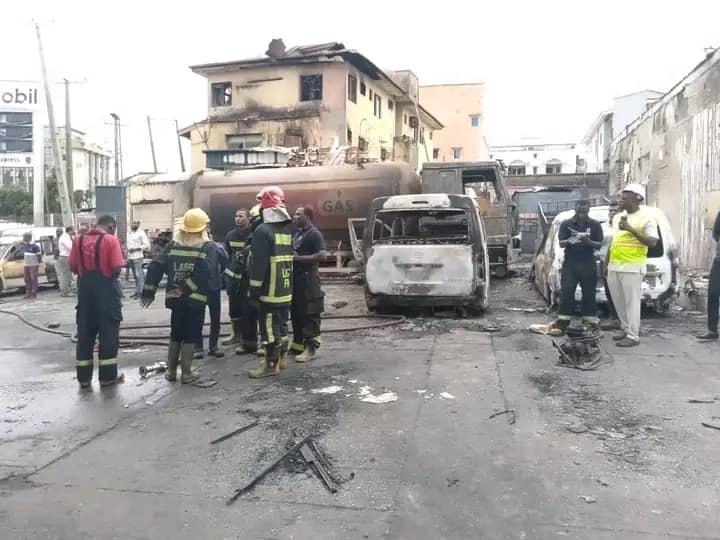
The fire at an NNPC-affiliated filling station in Alimosho spread to the adjoining St Lawrence Greater Height School.
The Nigerian National Petroleum Company Limited (NNPC) has commenced an investigation into a fire outbreak at one of its affiliated filling stations in Alimosho Local Government Area of Lagos State, after the inferno spread to a neighbouring school and destroyed several properties.
The incident occurred on Monday, November 16, 2026, at a filling station along Ekoro-Ajasa Road, around the Command-Ejigbo area of Lagos. The fire reportedly affected the station and adjoining St Lawrence Greater Height School, leaving significant damage to classrooms, vehicles and fuel dispensing equipment.
Although the fire caused extensive property damage, emergency responders successfully brought the situation under control. No deaths or injuries were reported.
NNPC confirmed that it had commenced a review of the incident, with its Retail, Health, Safety and Environment teams working alongside the management of the affiliated filling station and relevant authorities to establish what happened.
NNPC Begins Investigation into Lagos Fire
The national oil company disclosed its response in a statement issued by its Chief Corporate Communications Officer, Andy Odeh.
According to the company, the fire had been contained by emergency responders, while preliminary information indicated that no fatalities or injuries had been recorded.
NNPC said its relevant teams and the management of the affected station were reviewing the circumstances surrounding the outbreak.
The company also expressed concern over the distress caused to residents, customers and businesses in the area, particularly those whose properties or livelihoods may have been affected.
NNPC stated that it would support the relevant authorities and the station’s management during the investigation and provide further updates when verified information becomes available.
The company also commended the Lagos State Emergency Management Agency (LASEMA), the Lagos State Fire and Rescue Service and other emergency responders for their intervention.
It reiterated that the safety of customers, employees and neighbouring communities remained a priority.
How the Fire Started: LASEMA Gives Preliminary Account
While NNPC’s investigation is ongoing, the Lagos State Emergency Management Agency has provided a preliminary account of how the incident reportedly began.
According to LASEMA, initial findings indicated that the fire started while a tanker was discharging diesel at the filling station.
The flames reportedly spread from the tanker to the station’s fuel dispensing pumps before extending to the adjoining St Lawrence Greater Height School.
The agency’s Igando-based Beta Team was deployed to the location after receiving a distress call.
LASEMA Permanent Secretary, Dr Olufemi Oke-Osanyintolu, said emergency responders arrived to find the fire affecting both the filling station and the neighbouring school.
The preliminary account provides an indication of the circumstances surrounding the outbreak, but the final findings of the ongoing investigations are still awaited. NNPC has not announced a definitive cause or assigned responsibility for the incident.
Seven Classrooms, Vehicles and Fuel Pumps Destroyed
The fire left considerable damage at the filling station and the adjoining school.
Reports from the emergency response operation indicated that seven classrooms at St Lawrence Greater Height School were destroyed. Electrical appliances inside the affected classrooms were also damaged.
Three fuel dispensing pumps at the filling station were reportedly destroyed.
Two vehicles were also affected by the inferno: a DAF truck and a Toyota Camry with registration number EKY 430 JS.
The destruction of the school facilities is particularly significant because the fire spread beyond the petroleum retail premises into an educational facility situated beside the station.
The damage has raised concerns about the potential consequences of fire outbreaks at filling stations located close to schools, residential buildings and other public facilities.
Despite the extent of the destruction, emergency responders were able to prevent the situation from resulting in reported casualties.
Emergency Agencies Join Forces to Contain Inferno
Several emergency and security agencies participated in the operation to extinguish the fire and prevent it from spreading further.
They included the Lagos State Emergency Management Agency, Lagos State Fire and Rescue Service, National Emergency Management Agency (NEMA), Lagos State Ambulance Service, Lagos State Traffic Management Authority (LASTMA), Lagos Neighbourhood Safety Corps and officers of the Nigeria Police.
Their coordinated intervention helped bring the fire under control and limit further damage to nearby properties.
The response also involved firefighters and emergency personnel working to secure the affected area and prevent additional risks after the flames had been extinguished.
NNPC acknowledged the efforts of the emergency agencies, while LASEMA commended the responders for their contribution to the operation.
Lagos Government Warns Filling Station Operators and Tanker Drivers
Following the incident, the Lagos State Government renewed its appeal to filling station operators, tanker drivers and motorists to observe safety regulations.
Particular attention was drawn to safety procedures during the discharge of petroleum products, an operation that requires strict precautions because of the risks associated with handling flammable materials.
The government also advised motorists to maintain their vehicles properly, avoid speeding and refrain from dangerous overtaking.
School owners and managers were urged to ensure that emergency access routes around their facilities remained clear and that they cooperated with emergency responders whenever incidents occurred.
The appeal highlights the importance of preparedness and compliance with safety procedures, especially in densely populated parts of Lagos where commercial facilities, schools and residential properties may be situated close to one another.
Fire Raises Questions About Safety Around Filling Stations
The Alimosho incident has once again drawn attention to the risks associated with petroleum storage and handling facilities operating near public institutions.
The transfer of fuel from tankers into storage facilities is a sensitive operation that requires strict adherence to established safety procedures. Any failure in equipment, operational processes or emergency preparedness can create dangerous conditions for workers, customers and people in neighbouring buildings.
Where filling stations operate close to schools, homes and businesses, the potential consequences of an incident can extend well beyond the station’s premises.
The destruction of classrooms at St Lawrence Greater Height School demonstrates how quickly a fire at a petroleum retail outlet can affect an adjoining property.
The ongoing investigation by NNPC and the relevant authorities is therefore important not only in establishing what happened but also in determining whether additional safety measures or corrective actions are necessary.
For now, the preliminary findings point to a fire that reportedly began during diesel offloading. However, the final cause and any responsibility arising from the incident remain subject to the outcome of the investigation.
NNPC has promised to cooperate with the relevant authorities and provide further updates as verified information becomes available.
Residents and businesses affected by the incident will be looking to the findings for clarity, while the wider public will expect stronger attention to safety around petroleum facilities across Lagos State.
About the Author