
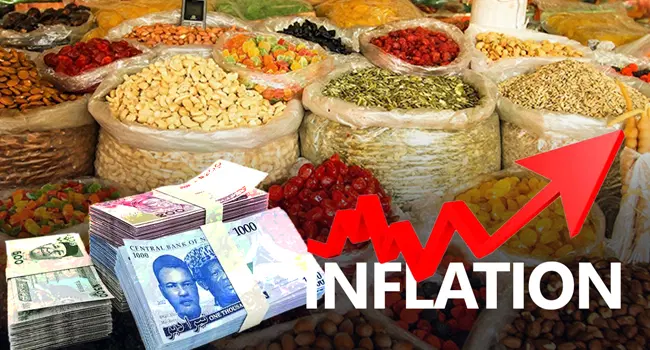
Nigeria recorded a major breakthrough in its battle against rising prices in November 2025, as headline inflation fell to 14.45 percent, the lowest level in five years and below President Bola Tinubu’s 15 percent target.
The latest figures, released by the National Bureau of Statistics (NBS) in its Consumer Price Index (CPI) report on Monday, confirm that inflation has now declined for eight consecutive months this year, reinforcing signs that price pressures are steadily easing after years of persistent acceleration.
The November figure marks a sharp moderation from the 16.05 percent recorded in October and continues a disinflation trend that began in April 2025. According to Central Bank of Nigeria (CBN) data, inflation is now back to levels last seen during the COVID-19 period in late 2020.
On a year-on-year basis, the NBS said headline inflation in November 2025 was 20.15 percentage points lower than the 34.60 percent recorded in the same month last year, highlighting the scale of the slowdown.
“This shows that the headline inflation rate decreased in November 2025 compared to the corresponding period of 2024,” the bureau stated.
Monthly Price Pressures Persist
Despite the annual improvement, inflationary pressures have not fully disappeared. On a month-on-month basis, headline inflation rose to 1.22 percent, up from 0.93 percent in October. This suggests that while prices are rising more slowly year-on-year, the pace of price increases accelerated slightly during the month.
Food Inflation Shows Significant Relief
Food prices — a major driver of household hardship — also showed notable improvement. Food inflation declined to 11.08 percent year-on-year in November, down sharply from 39.93 percent in November 2024.
The NBS explained that the steep annual decline was partly due to a change in the base year, which moderates year-on-year comparisons. Still, the data confirms a significant easing from last year’s extreme food price spikes.
On a month-on-month basis, however, food inflation rose to 1.13 percent, compared to -0.37 percent in October, reflecting renewed increases in the prices of staples such as dried tomatoes, cassava tubers, ground pepper, eggs, crayfish, egusi, oxtail, periwinkle and fresh onions.
The 12-month average food inflation rate fell to 19.68 percent as of November 2025, down from 38.67 percent a year earlier.
Wide Variations Across States
Inflation trends varied significantly across states. On a year-on-year basis, food inflation was highest in Kogi (17.83 percent), Ogun (16.52 percent) and Rivers (16.11 percent). The slowest increases were recorded in Imo (3.52 percent), Katsina (3.65 percent) and Akwa Ibom (4.52 percent).
Month-on-month figures showed sharper volatility. Yobe (9.52 percent), Katsina (6.61 percent) and Ondo (6.04 percent) recorded the steepest increases, while Imo (-6.49 percent), Nasarawa (-5.48 percent) and Enugu (-2.54 percent) saw outright declines in food prices.
Monetary Policy Impact
The sustained slowdown comes amid tight monetary conditions. On November 25, the Central Bank of Nigeria’s Monetary Policy Committee (MPC) retained the policy rate at 27 percent, maintaining its hawkish stance to anchor inflation expectations, stabilise the naira and consolidate recent gains.
Economists say the data suggests that aggressive monetary tightening, improved food supply conditions and base effects are beginning to deliver results. However, they warn that risks remain from food supply disruptions, energy costs and seasonal spending pressures.
Still, the November inflation outcome marks a symbolic and economic milestone. By falling below the government’s target and hitting a five-year low, the data offers renewed optimism that Nigeria may be turning a corner in its long struggle with rising prices — with positive implications for consumer welfare, interest rates and overall economic stability.
About the Author