
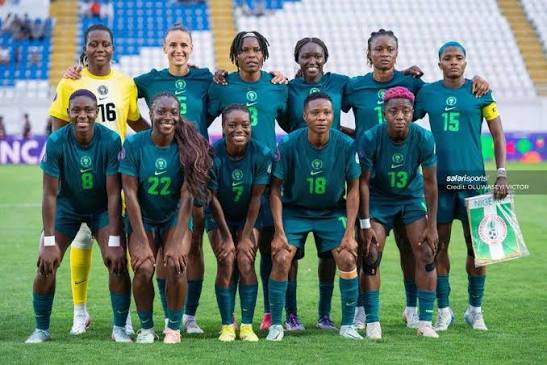
Nigeria’s Super Falcons have dropped seven places to 43rd in the latest FIFA Women’s World Ranking, suffering one of the biggest setbacks in their recent international history after a disappointing run at the 2026 Women’s Africa Cup of Nations (WAFCON).
The latest ranking, released by FIFA on Tuesday, October 20, 2026, saw Nigeria fall from 36th position in the previous edition published in June to 43rd globally. The team’s rating also dropped by 83.54 points, from 1,601.56 to 1,518.02.
Despite the decline, the Super Falcons remain Africa’s highest-ranked women’s national football team, maintaining their position ahead of South Africa, Cameroon, Morocco, Ghana and Zambia.
The latest figures, however, highlight the consequences of Nigeria’s difficult international campaign, which included an early exit from WAFCON in Morocco and defeat in a subsequent play-off for qualification for the 2027 FIFA Women’s World Cup in Brazil.
The development represents a significant setback for a team widely regarded as the traditional powerhouse of African women’s football. Nigeria have won the Women’s Africa Cup of Nations a record 10 times and have appeared at every edition of the FIFA Women’s World Cup since the inaugural tournament in 1991.
The latest ranking decline places renewed attention on the team’s consistency, preparations for future competitions and efforts to restore its position among the world’s leading women’s football nations.
What the latest FIFA ranking shows
The October ranking reflects the results of 183 international matches played since the previous update.
Nigeria’s seven-place fall was accompanied by a loss of 83.54 ranking points, the largest points decline recorded by any national team in the latest update.
The figures illustrate how a difficult sequence of competitive matches can affect a team’s standing under FIFA’s ranking system, which evaluates national teams based on their international results and the strength of their opponents.
For Nigeria, the consequences extend beyond a change in position on the global list. The results that contributed to the decline also ended the team’s hopes of securing a place at the 2027 Women’s World Cup through the African qualification route.
Nevertheless, remaining Africa’s top-ranked women’s team provides the Super Falcons with an important foundation as they seek to recover from the disappointing campaign.
Their position also reflects the team’s long-term achievements, including its continental titles and history of competing against leading national teams at major international tournaments.
The challenge now is to translate that history into stronger performances and more consistent results in upcoming fixtures.
WAFCON campaign ends in disappointment
Nigeria’s difficult run was most evident during the 2026 Women’s Africa Cup of Nations, hosted by Morocco.
The Super Falcons entered the tournament with high expectations but suffered an unexpected 3-2 defeat against Malawi in their opening match.
The result was a major disappointment for the Nigerian side, which had been expected to challenge for the continental title and progress deep into the competition.
Nigeria responded by defeating Zambia 1-0 before recording an emphatic 6-2 victory over Egypt to secure a place in the quarter-finals.
The win over Egypt demonstrated the team’s attacking potential and suggested that Nigeria could still mount a strong challenge for the title despite the difficult opening result.
However, the quarter-final stage proved decisive.
The Super Falcons lost 1-0 to Cameroon on August 9, ending their campaign before the semi-finals.
The defeat was particularly significant because it marked the first time Nigeria had failed to reach the semi-final stage of the Women’s Africa Cup of Nations.
For a team with 10 continental titles, the early elimination represented an unusual disappointment and raised questions about its ability to maintain its traditional dominance in African women’s football.
The result also had implications for the team’s FIFA ranking, as Nigeria missed the opportunity to earn additional points through further progress in the tournament.
Defeat against South Africa compounds Nigeria’s setback
Nigeria’s disappointment continued after WAFCON, when the Super Falcons faced South Africa in a play-off in Casablanca on August 13.
The match carried major significance because Nigeria needed a positive result to keep its hopes of qualifying for the 2027 FIFA Women’s World Cup alive.
South Africa secured a 2-1 victory, with Thembi Kgatlana and Refiloe Jane scoring for Banyana Banyana.
Nigeria responded late in the match when substitute Christy Ucheibe converted a penalty in stoppage time, but the goal was not enough to prevent defeat.
The result ended Nigeria’s hopes of reaching the 2027 Women’s World Cup through the play-off route.
It also meant that the Super Falcons would miss the tournament for the first time since the competition began in 1991.
The development is a major concern for Nigerian women’s football because the team’s consistent participation in the global tournament has long been one of its defining achievements.
Missing the next edition would represent a significant break in that record and place greater pressure on the football authorities to review the team’s preparation, technical direction and development strategy.
The defeat against South Africa also formed part of the difficult international period reflected in the latest FIFA ranking.
Nigeria remains Africa’s highest-ranked women’s team
Although the Super Falcons have fallen in the global rankings, they continue to lead African women’s football in FIFA’s latest assessment.
Nigeria occupies 43rd position worldwide, ahead of South Africa, which is ranked 59th, and Cameroon in 62nd place.
Morocco follows in 64th position, while Ghana is ranked 65th. Zambia occupies 70th place.
Côte d’Ivoire sits 72nd, followed by Algeria in 73rd, Senegal in 76th and Mali in 86th.
The figures show that African women’s football remains competitive, with several national teams working to improve their results and close the gap with established continental leaders.
Nigeria’s continued position at the top of the African rankings is a reminder that the Super Falcons retain a strong standing despite their recent difficulties.
However, maintaining that advantage will require improved performances in future international fixtures, particularly as other African teams continue to progress.
The growth of women’s football across the continent means that Nigeria cannot rely solely on its history or reputation to maintain its position.
Consistent results, effective preparation and the development of talented players will remain essential to protecting the team’s standing.
Malawi records the biggest rise in the rankings
While Nigeria suffered a major decline, Malawi emerged as one of the biggest success stories in the October FIFA ranking update.
The Malawi women’s national team, popularly known as the Scorchers, climbed an extraordinary 49 places to reach 104th position globally.
The team gained 158.44 ranking points, the largest increase recorded by any nation in the latest update.
Malawi’s rise followed its impressive performance at WAFCON, where it overcame several established opponents and reached the final of the competition.
Its progress also secured qualification for the 2027 FIFA Women’s World Cup in Brazil, marking the country’s first appearance at the global tournament.
The Scorchers’ rise illustrates how strong performances at major competitions can transform a national team’s international standing.
It also demonstrates the increasing competitiveness of women’s football in Africa, where emerging teams are becoming more capable of challenging established sides.
Cameroon, which defeated Malawi in the WAFCON final, also improved its position, climbing nine places to 62nd in the world.
Tanzania rose 11 places to 111th, while Burkina Faso moved up nine positions to 109th.
These gains contrast sharply with Nigeria’s decline and underline the importance of consistent performances at continental and international levels.
Egypt suffers the largest African ranking fall
Egypt recorded the biggest decline in ranking positions among African teams in the latest update.
The Egyptian women’s national team dropped 14 places to 113th after losing all three of its group-stage matches at WAFCON.
Zimbabwe also experienced a setback, falling nine places to 136th, while the Democratic Republic of Congo dropped eight positions to 114th.
The contrasting results show that the latest ranking update brought significant changes across African women’s football.
For Nigeria, the challenge will be to learn from the tournament and ensure that future performances reflect the quality and experience associated with the national team.
The movement of other African teams also reinforces the need for sustained investment in coaching, player development, competitive opportunities and technical planning.
Spain maintains the top position globally
At the top of the FIFA Women’s World Ranking, Spain retained first place following its October international fixtures against the United States.
Spain defeated the Americans 2-0 in Washington, DC, before the teams played out a 2-2 draw in Chester, Pennsylvania.
The results helped Spain extend its lead over the United States to almost 80 ranking points.
The Americans remained second, while Germany occupied third position after recording victories in both of its home friendly matches.
England and Japan completed the top five, followed by France, Brazil, Sweden and Canada.
Denmark was the only team to change position within the global top 10, climbing two places to 10th following a draw and a victory against Canada.
The Danish side returned to the top 10 for the first time since August 2010.
The next FIFA Women’s World Ranking update is scheduled for December 7, 2026.
Super Falcons face pressure to rebuild momentum
Nigeria’s latest ranking decline raises questions about the team’s preparations and the measures required to restore its competitive form.
The Super Falcons have historically benefited from a strong pool of players competing domestically and abroad. Their record at WAFCON and the Women’s World Cup has also helped establish Nigeria as a major force in African women’s football.
However, recent results show that historical success does not guarantee continued dominance.
The defeat against Malawi, the quarter-final loss to Cameroon and the subsequent play-off defeat to South Africa exposed the difficulties the team faced during a crucial period.
A response will require careful assessment of the tournament campaign, technical performance, squad depth and preparation for future international matches.
The Nigeria Football Federation will also need to ensure that the team has a clear competitive plan and adequate opportunities to prepare for major fixtures.
The latest ranking does not erase the Super Falcons’ achievements, but it provides a clear indication of the work required to improve their position.
Nigeria’s immediate objective will be to regain consistency, strengthen its performances against strong opponents and rebuild momentum ahead of future competitions.
The Super Falcons’ fall from 36th to 43rd in the latest FIFA Women’s World Ranking marks a difficult moment for Nigerian women’s football.
The loss of 83.54 ranking points follows a disappointing WAFCON campaign, a historic quarter-final elimination and defeat against South Africa in the play-off for the 2027 Women’s World Cup.
Despite the setbacks, Nigeria remains Africa’s highest-ranked women’s national team, retaining a position ahead of South Africa, Cameroon, Morocco and Ghana.
The rise of Malawi and improvements by other African teams also demonstrate that competition on the continent is becoming increasingly demanding.
For Nigeria, the next challenge is to turn the disappointment into an opportunity for rebuilding and improvement.
The Super Falcons still possess a rich footballing history, but restoring their global standing will depend on stronger results, consistent preparation and the ability to convert their experience into success on the pitch.
About the Author