
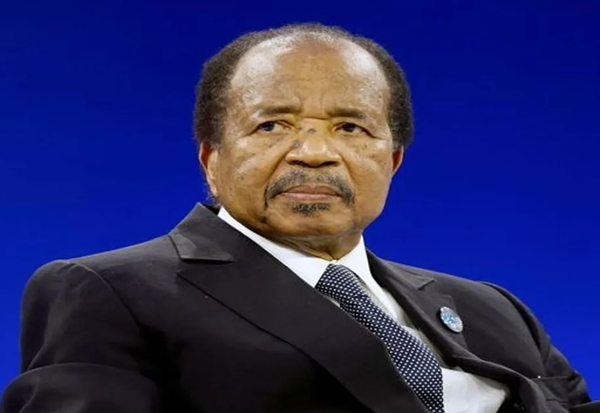
President Paul Biya of Cameroon, at 89 years old, has reached a milestone of 40 years as head of state, taking office in 1982.
As one of the world’s oldest leaders, he is Africa’s second longest-serving leader, following Equatorial Guinea’s Teodoro Obiang Nguema, who has been in power since 1979.
During Biya’s tenure, Cameroon enjoyed an extended period of political stability, which was eventually disrupted by an Anglophone rebellion in the south-west and north-west regions and the influx of radical Islamists from Nigeria.
Biya has faced persistent domestic pressure to accept a transition.
Despite this, Biya remains evasive regarding his intentions to relinquish power in 2025, which would represent the culmination of his seventh term in office.
What are the underlying reasons for Biya’s extended tenure, and why has Cameroon failed to engineer a seamless transition?
As a researcher focused on democratic studies and regime types in Africa, with a strong interest in African political developments, I am driven to explore a crucial issue.
What underlying factors are responsible for the proliferation of ageing presidents in Africa, when the continent’s progress and development depend on the emergence of young, agile, and forward-thinking leaders?
In 1982, Paul Biya succeeded Ahmadou Ahidjo, who had served as Cameroon’s president since 1960, after Ahidjo’s unexpected resignation.
Ahidjo’s presidency was marred by an economic crisis and widespread corruption. His tenure was also characterised by a one-party state and a highly centralised presidency.
Upon becoming president, Biya pledged to implement political liberalisation reforms, including democracy, civil and human rights, and economic development in Cameroon.
For a time, he strove to accomplish some of these objectives. The country realized political stability and unity, and relative economic transformation through his “new deal”.
There was even a fleeting relaxation of the draconian police state. Nonetheless, in the late 1990s, there was a gradual slowdown of political liberalisation, fiscal discipline, and government accountability.
This transpired after the 1984 bloody coup attempt by the Republican Guards. Biya became increasingly resistant to political accommodation.
Firstly, he removed Ahidjo’s faction within the ruling party and eventually precluded any meaningful challenge to his leadership from within or outside the party.
Ultimately, under external pressure, he consented to a multiparty dispensation in 1990.
Over time, this has been systematically and gradually depleted, resulting in a monolithic system that has kept Biya in office for 40 years.
Cameroon’s politics has long been characterized by the dominance of Biya’s Rassemblement Démocratique du Peuple Camerounaise, which was previously known as the Cameroon National Union until 1985 and had been the dominant party since 1966, but this dominance has gradually diminished after the country transitioned to multipartyism.
The institutionalization of political parties has been unsuccessful, leading to the emergence of hundreds of small parties – with over 300 currently in existence – many of which are allegedly secretly bankrolled and controlled by Biya.
This has created a façade of democratic competitiveness while weakening legitimate opposition.
The lack of a united and consolidated opposition has enabled the ruling party to establish a dominant party system, holding a significant majority in both the National Assembly and the Senate, with 63 seats out of 70.
This undermines the possibility of genuine checks and balances. Additionally, the party has utilized electoral mechanics such as boundary manipulation and outright fraud to expand victories and consolidate majorities.
The electoral process has become a mere technicality, with Biya’s victory being a foregone conclusion. Notably, in 2004 Biya won with 70.9% of the vote.
After the 2008 constitutional amendment to remove term limits, he secured re-election with 78% of the vote in 2011. In 2018, he obtained 71.28% against his opponent, opposition leader Maurice Kamto.
President Biya has cultivated a political class that executes his directives while maintaining his hold on power with minimal opposition.
As a leading African timber exporter and fifth-largest global cocoa producer, Cameroon possesses sufficient resources to alleviate extreme poverty and underdevelopment.
However, corruption and clientelism divert these funds. Politicians must demonstrate allegiance to Biya to avoid marginalization or incarceration.
Furthermore, Biya has appointed individuals from his southern ethnic group to senior administrative, military, and civil service positions, relying notably on the Rapid Intervention Battalion to prevent potential military coups.
The Anglophone conflict has also provided Biya with an opportunity to shift focus away from his mismanagement.
The violent conflict has claimed thousands of lives in a civil war against the secessionist English-speaking regions of the country.
Biya, backed by French and recently Russian supporters, has exploited the conflict to bolster his domestic position and deflect international criticism.
Another factor is the concentration of power in Cameroon. All significant decisions require the president’s endorsement.
No government branch or state entity is exempt from oversight, including the judiciary: judges are directly nominated by the president.
To put it simply, the Biya regime has had a profound impact on all facets of public life.
Contemplating a post-Biya era
The president’s current mandate concludes in 2025, when he will reach the age of 92. Despite showing no intention of stepping down, speculation about a post-Biya era is escalating.
Although the ruling party has not held a party congress since 2011, thereby suppressing the transition debate, the party engages in periodic internal reorganisation.
The president has utilised this process to reward loyalty and counterbalance potential threats to his supremacy.
Biya’s presidency has long outlived its usefulness, sustained by a combination of ruthlessness and adroit politics.
The country’s democracy has suffered as a result, with entrenched fissures that can only be addressed through a change of leadership.
Furthermore, this change is an eventuality that even Biya’s considerable influence cannot forestall.
About the Author