
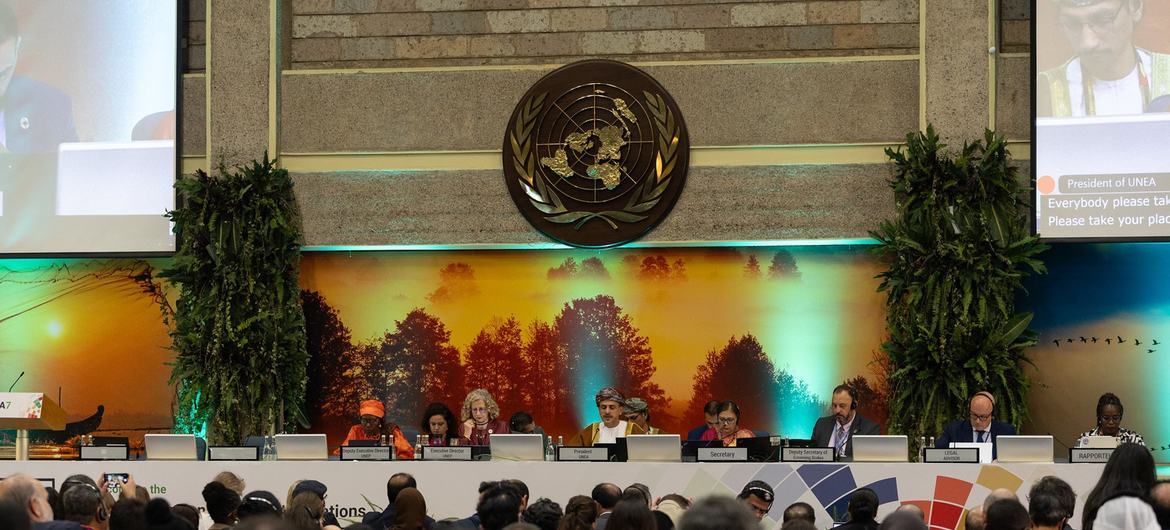
The seventh session of the United Nations Environment Assembly (UNEA-7) concluded on Friday, December 12, 2025, with Member States adopting 11 resolutions, three decisions, and a Ministerial Declaration aimed at advancing multilateral solutions for a more resilient planet.
Held at the United Nations Environment Programme (UNEP) headquarters in Nairobi, the week-long Assembly drew more than 6,000 participants from 186 countries. Deliberations focused on addressing the triple planetary crisis of climate change, biodiversity and nature loss, land degradation, and pollution and waste.
Key Resolutions Target Climate, Nature and Innovation
The resolutions adopted at UNEA-7 advanced international efforts in several critical areas, including the protection of coral reefs, sustainable management of minerals and metals vital to the global energy transition, and the sound management of chemicals and waste.
Other measures addressed the sustainable use of artificial intelligence, the role of sport in driving sustainability, international cooperation to combat wildfires, the environmental dimension of antimicrobial resistance, glacier protection, and responses to sargassum seaweed blooms.
President of UNEA-7 and President of Oman’s Environment Authority, Abdullah bin Ali Al-Amri, described the outcome as a demonstration of global resolve.
“What has been achieved here proves that this bridge is indeed capable of carrying the world’s ambitions towards a better future,” he said.
He cautioned, however, that success would ultimately be judged by tangible outcomes. “Our mission does not end with what we have adopted on paper, but with cleaner air and water, restored ecosystems, green job opportunities, and societies resilient enough to face future challenges.”
Ministerial Declaration and UNEP Strategy Approved
The UNEA-7 Ministerial Declaration commits Member States to bold action, the full implementation of multilateral environmental agreements, and inclusive and equitable participation in environmental governance.
The Assembly also approved UNEP’s Medium-Term Strategy for the next four years, alongside its Programme of Work for the coming two years, providing a roadmap for global environmental action.
In her closing remarks, UNEP Executive Director Inger Andersen urged Member States to ensure full financial contributions to enable meaningful implementation.
“Outside these halls, people are losing lives, livelihoods, and homes because environmental action has not been fast or strong enough,” Andersen said. “You have lit the path forward. Now we must move quickly together to deliver real solutions for resilient people and a resilient planet.”
Science, Youth and Local Voices Take Centre Stage
UNEA-7 featured the second Multilateral Environmental Agreements Day, highlighting the role of international environmental law in tackling global and regional challenges.
The Assembly also launched the seventh Global Environment Outlook, the most comprehensive environmental assessment to date. The report found that investing in climate stability, healthy ecosystems, and pollution-free environments could generate trillions of dollars in global GDP, prevent millions of deaths, and lift hundreds of millions out of poverty and hunger.
Ahead of the main Assembly, more than 1,000 young delegates participated in the Youth Environment Assembly, advocating for stronger youth inclusion in global decision-making. A Cities and Regions Summit underscored the critical role of local governments in driving transformative environmental solutions.
Civil society engagement was further strengthened through the Global Major Groups and Stakeholders Forum.
Celebrating Environmental Leadership
The Assembly also celebrated the 2025 UN Champions of the Earth and recognised new UN World Restoration Flagships during a Gala of Hope.
UNEP Goodwill Ambassadors reinforced key messages throughout the week. Endurance swimmer and UNEP Patron of the Oceans, Lewis Pugh, climbed Mount Kenya to spotlight the rapid loss of Africa’s remaining glaciers, while Tanzanian artist Frida Amani performed a new song, Resilience, alongside the Kenya Boys Choir.
Leadership Transition and Next Assembly Announced
UNEA-7 elected Jamaica’s Minister of Water, Environment and Climate Change, Matthew Samuda, as President of UNEA-8.
“Our voices carry the weight of communities on the frontlines of climate impacts,” Samuda said, pledging to lead an inclusive, transparent, and action-oriented Assembly focused on strengthening science-policy links, scaling up adaptation financing, and accelerating sustainable production and consumption.
Member States agreed that the next UN Environment Assembly, UNEA-8, will be held from December 6 to 10, 2027, at UNEP headquarters in Nairobi.
About the Author