
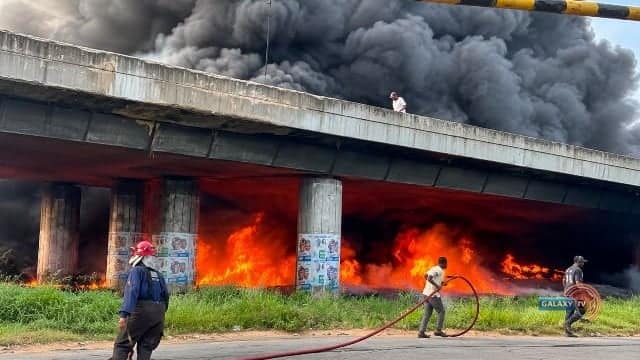
Two men have sustained severe burn injuries after a diesel-laden tanker plunged from Otedola Bridge along the Lagos-Ibadan Expressway and burst into flames, triggering an emergency response and traffic disruption in Lagos.
A fire outbreak at Otedola Bridge in Lagos State caused panic and traffic congestion on Monday, October 19, 2026, after a diesel tanker fell from the bridge and erupted into flames beneath it.
The incident occurred along the busy Lagos-Ibadan Expressway, around the Berger-bound corridor, where the tanker reportedly plunged into the underpass below the bridge. The crash triggered a major fire, prompting emergency responders to mobilise to the scene to rescue victims, extinguish the flames and prevent further damage.
The Lagos State Traffic Management Authority (LASTMA) confirmed that two people sustained severe burn injuries in the incident. The victims were rescued and evacuated for medical treatment as firefighters worked to contain the blaze.
The Federal Road Safety Corps (FRSC) subsequently reported that preliminary findings pointed to speeding as a possible cause of the crash. However, officials have also stated that investigations are ongoing to establish the full circumstances surrounding the incident. (PUNCH, TVC News, Channels Television)
Two People Sustain Severe Burn Injuries
According to LASTMA, two men sustained serious burn injuries when the diesel tanker fell from the bridge and caught fire beneath it.
The agency’s emergency response personnel worked with other relevant authorities to rescue the victims from the affected area.
The Lagos State Emergency Management Agency (LASEMA), through its Rescue Unit, evacuated the injured men to the Lagos State Accident and Emergency Centre at Toll Gate for immediate medical attention.
The severity of the injuries made urgent medical intervention necessary. The FRSC’s initial crash report stated that the two adult male occupants sustained injuries and that no fatalities had been recorded in its initial report.
In a later interview with TVC News, an FRSC official said the injured victims had been referred to the Lagos State University Teaching Hospital (LASUTH) after an initial hospital could not provide the required treatment.
As of the latest reports available on October 19, there was no confirmed report of a death arising from the incident. The victims’ injuries were, however, described as severe.
The circumstances surrounding the crash also meant that emergency responders had to contend with both the immediate danger posed by the fire and the risk of further harm to people in the surrounding area. (The Guardian Nigeria, TVC News)
How the Tanker Fire Started
The tanker was reportedly carrying diesel when it lost control, fell from Otedola Bridge and crashed beneath the structure, triggering the fire.
The FRSC said the crash occurred at approximately 4:10 p.m. on Monday on the Lagos-Ibadan Expressway. According to the corps, its rescue unit arrived at the scene at about 4:20 p.m., following a report received at approximately 4:15 p.m.
Separately, LASEMA confirmed that it had received a distress alert concerning the tanker fire and dispatched its response team to the scene.
The Federal Road Safety Corps later identified speeding as the preliminary reported cause of the incident in a statement issued by its Lagos Sector Command.
However, Deputy Corps Commander Emma Fekoya, the FRSC’s Head of Operations in Lagos State, told TVC News that investigators were considering several possible factors. These included driver fatigue and the possibility that another vehicle had cut across the tanker.
Fekoya explained that the exact circumstances had not yet been conclusively established. Investigators also needed to speak with the driver, whose medical condition had delayed the interview.
The distinction is important because the preliminary identification of speeding does not necessarily establish every factor that contributed to the crash. The authorities’ investigation is expected to provide further clarity.
Until the investigation is concluded, other possible contributing circumstances should not be treated as confirmed causes.
Firefighters and Emergency Agencies Respond
Several emergency and security agencies participated in the operation to rescue the victims and contain the fire.
The Lagos State Fire and Rescue Service deployed firefighters to extinguish the flames and prevent the fire from spreading to surrounding areas and infrastructure.
LASTMA personnel assisted with the rescue operation and managed traffic around the affected corridor. LASEMA’s Rescue Unit handled the evacuation of the injured victims, while the FRSC, Lagos State Neighbourhood Safety Agency and police personnel from the Alausa Police Division also participated in the coordinated response.
The agencies’ involvement was particularly important because the incident occurred beneath a major bridge on a heavily used expressway. A tanker fire in such a location can threaten road users, nearby structures and people within the immediate vicinity.
Emergency teams therefore had to work to control the blaze, assist the injured and reduce the risk of further casualties while managing the surrounding traffic.
LASEMA later reported that the fire had been extinguished, while TVC News reported that traffic flow had been restored along the corridor.
The response demonstrated the importance of coordination among emergency services when a road crash involving petroleum products develops into a fire emergency.
Traffic Disruption on the Lagos-Ibadan Expressway
The fire caused traffic congestion around Otedola Bridge as motorists attempted to avoid the affected section of the expressway.
LASTMA advised drivers approaching the area to exercise extreme caution and obey instructions from traffic officials while emergency operations were underway.
Some motorists rerouted to avoid the scene, contributing to disruption around the bridge and the adjoining road network.
Otedola Bridge is located along a strategic transport corridor linking Lagos with other parts of southwestern Nigeria and routes leading to other regions of the country. Incidents on this stretch can affect commuters, commercial vehicles, public transport operators and motorists travelling between Lagos and neighbouring areas.
A crash involving a tanker can cause particularly serious disruption because emergency responders may need to secure a wider area while extinguishing the fire and checking for other hazards.
Although the fire was later reported extinguished and traffic flow restored, motorists were advised to remain cautious around emergency scenes and follow instructions from the relevant authorities.
Road users should also avoid stopping close to a burning tanker to take photographs or videos, as doing so can expose them to danger and obstruct emergency personnel.
FRSC Warns Tanker Operators Against Speeding
Following the incident, the FRSC emphasised the dangers of excessive speed, particularly among drivers operating heavy-duty vehicles carrying petroleum products.
The corps noted that tankers require careful speed management, adequate following distances, sound vehicle maintenance and strict compliance with road safety regulations.
Heavy-duty vehicles have substantial mass and require appropriate braking distances. When a driver loses control, the consequences can be more severe than those associated with many ordinary vehicle crashes, especially when the vehicle is transporting combustible material.
The FRSC also urged tanker owners and fleet operators to strengthen driver training and supervision, conduct regular mechanical inspections and ensure that journey schedules do not encourage unsafe driving.
The agency stressed that commercial pressure should never take priority over the preservation of human life.
These recommendations apply not only to diesel tankers but also to other articulated vehicles transporting hazardous or combustible cargo.
Drivers approaching emergency scenes were also urged to reduce speed, maintain a safe distance, obey traffic control instructions and avoid obstructing rescue teams.
The incident highlights the need for road safety measures to extend beyond drivers alone. Vehicle owners, transport companies, maintenance teams and regulators all have roles in ensuring that heavy-duty vehicles are operated safely.
Concerns Over Repeated Tanker Incidents in Lagos
The Otedola Bridge fire has renewed attention on the dangers associated with tanker crashes on major Lagos roads.
The Lagos-Ibadan Expressway is an important route for commuters and the movement of goods. Tankers and other heavy-duty vehicles also use the corridor to transport petroleum products and other cargo.
When such vehicles are involved in serious crashes, the consequences can extend beyond the immediate victims. Fires can damage infrastructure, disrupt traffic, threaten nearby residents and businesses, and require substantial emergency resources.
The latest incident also follows other tanker-related accidents in Lagos. Channels Television noted that a 33,000-litre tanker had recently overturned at Ojota Bridge, spilling its groundnut oil cargo onto the road. That incident occurred several kilometres from Otedola Bridge.
Although the cargo and circumstances differed, such incidents underline the importance of vehicle roadworthiness, appropriate speed, careful driving and effective enforcement of safety requirements.
Regular inspection of braking systems, tyres and other critical components is particularly important for heavy-duty vehicles. Operators must also ensure that drivers are adequately rested and that vehicles are not subjected to unsafe operating conditions.
Authorities will need to establish the circumstances of individual crashes rather than assume that every tanker incident has the same cause.
The FRSC has indicated that investigations are ongoing to determine the circumstances surrounding the Otedola Bridge crash.
The condition of the driver was identified as a factor delaying investigators’ efforts to obtain his account of what happened. Information from the driver, vehicle inspections and other evidence may help clarify the sequence of events leading to the crash.
Emergency agencies have also reported that the fire was extinguished and traffic flow restored. The immediate priorities were rescuing the injured, containing the blaze and preventing further harm.
Further verified information about the victims’ recovery, the extent of any infrastructure damage and the final findings of the investigation would help establish the full impact of the incident.
Until then, the reported speeding factor should be understood as a preliminary finding rather than a complete explanation of the crash.
The fire beneath Otedola Bridge on October 19, 2026, followed a diesel tanker crash that left two men with severe burn injuries and disrupted traffic on the Lagos-Ibadan Expressway.
LASTMA, LASEMA, the FRSC, the Lagos State Fire and Rescue Service, police personnel and other emergency responders participated in the rescue and firefighting operation. The fire was subsequently reported extinguished, and traffic flow was restored.
While preliminary FRSC findings identified speeding as the reported cause, officials have said investigations are continuing to establish the full circumstances surrounding the incident.
The crash serves as a reminder of the serious risks associated with heavy-duty vehicles transporting petroleum products and the importance of responsible driving, vehicle maintenance and effective safety enforcement.
For motorists, tanker operators and transport companies, the priority remains the same: preventing avoidable crashes, protecting lives and ensuring that road safety takes precedence over speed or commercial pressure.
About the Author