
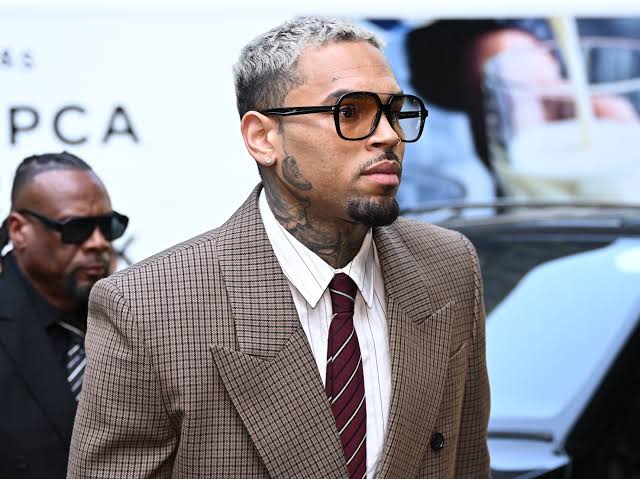
American R&B superstar Chris Brown has been sentenced to eight months in prison by a British court over a violent nightclub incident in London in 2023. However, the Grammy-winning singer will not serve the sentence immediately after the court suspended it for 12 months.
The 37-year-old entertainer was sentenced on Monday, October 26, 2026, at Southwark Crown Court in London after pleading guilty to affray over an attack on music producer Abraham Diaw at Tape nightclub in February 2023.
The ruling brings a major development in a case that attracted international attention after Brown was arrested in Britain in May 2025, more than two years after the incident. The arrest had threatened to disrupt his international concert tour before he was released on bail under financial security conditions.
Judge Tony Baumgartner described the nightclub violence as serious and warned that Brown’s celebrity status did not entitle him to special treatment under the law.
“Your fame, commercial success and professional standing do not entitle you to special treatment,” the judge told the singer, emphasising that the law applies equally to everyone.
Although Brown received a prison sentence, its suspension means he will avoid immediate imprisonment provided he complies with the applicable legal conditions. If he commits another offence during the 12-month suspension period, he could face imprisonment under the terms of the sentence.
What Happened at the London Nightclub?
The case concerns an incident at Tape, a private members’ nightclub in the Mayfair district of London, on February 19, 2023.
According to prosecutors, Brown attacked music producer Abraham Diaw on the club’s dance floor using a glass tequila bottle. The incident was captured on surveillance footage, which was later presented during the legal proceedings.
Prosecutors said Brown struck Diaw twice on the head with the bottle before swinging it at him again. The attack reportedly continued as the victim attempted to move away from the confrontation.
Brown’s vocal coach and associate, Omololu Akinlolu, was also accused of participating in the violence. Prosecutors said Akinlolu joined the incident and assaulted Diaw.
The confrontation lasted approximately 20 seconds, according to accounts presented in court. Despite its relatively short duration, prosecutors described the incident as a serious and unprovoked attack in a crowded entertainment venue.
Diaw sustained injuries to his head and knee and required hospital treatment. The use of a glass bottle against a person’s head was a central concern during sentencing because of the risk of more serious injury.
The case attracted considerable attention because Brown is an internationally recognised entertainer with a career spanning more than two decades.
Why Was Chris Brown Not Sent to Prison Immediately?
Although Brown received an eight-month prison sentence, the judge decided to suspend it for 12 months.
A suspended prison sentence is a custodial sentence that does not have to be served immediately, provided the person complies with the conditions imposed by the court. If the conditions are breached, or the person commits another offence during the relevant period, the court may order imprisonment in accordance with the law.
The decision followed Brown’s guilty plea to affray, a public-order offence involving the use or threat of unlawful violence in circumstances that cause others to fear for their safety.
The court considered the seriousness of the incident while also taking account of mitigating circumstances presented during sentencing.
Reports of the proceedings indicated that the judge considered Brown’s guilty plea, stable employment, charitable work and record in recent years when deciding that immediate imprisonment was not necessary.
The judge nevertheless made clear that the attack was dangerous. Repeatedly striking someone on the head with a glass bottle created a risk of substantially more serious injury than the victim ultimately sustained.
The sentence therefore represents a formal criminal punishment, even though Brown was allowed to leave court without beginning an immediate prison term.
It is important to distinguish between being sentenced to prison and being required to serve that sentence immediately. In Brown’s case, the court imposed a custodial sentence but suspended its execution for a year.
Brown’s Vocal Coach Also Receives a Suspended Sentence
Brown was not the only person sentenced over the incident. His associate and vocal coach, Omololu Akinlolu, who performs under the name Hoody Baby, also pleaded guilty to affray.
Akinlolu, 40, received a four-month prison sentence suspended for 12 months.
Prosecutors had alleged that he joined the attack after Brown struck Diaw with the bottle. The case against both men was resolved through guilty pleas to affray.
The plea agreements followed earlier denials of more serious allegations. Brown had previously denied charges including attempting to cause grievous bodily harm and assault occasioning actual bodily harm.
In return for the guilty pleas, prosecutors dropped those more serious charges, as well as a charge involving possession of an offensive weapon.
The final sentences were therefore imposed for affray, rather than convictions on the more serious charges that had initially been brought.
The outcome underscores the importance of accurately describing the offences for which defendants are convicted. While the prosecution’s account of the incident included the use of a bottle and injuries to Diaw, the sentences were imposed following the defendants’ admissions to affray.
The Judge’s Warning About Celebrity Status
One of the most widely reported moments from the sentencing was the judge’s warning that fame should not provide special treatment in criminal proceedings.
Brown has built a highly successful international music career, selling tens of millions of records and attracting a large global fan base. His supporters gathered outside Southwark Crown Court before the hearing, with some waiting for hours to see him arrive.
Several fans cheered as the singer left court after the sentence was announced.
However, the judge stressed that Brown’s professional success did not exempt him from the consequences of criminal conduct.
The court’s approach reflected the principle that sentencing should be based on the offence, the applicable law and relevant circumstances rather than a defendant’s celebrity profile.
The police also reinforced that message. Metropolitan Police Detective Chief Superintendent Christina Jessah said violence would not be accepted on London’s streets and that authorities would pursue those responsible regardless of their public profile or status.
The remarks served as a reminder that criminal proceedings involving internationally famous entertainers remain subject to the same legal framework that applies to other defendants.
Brown’s 2025 Arrest and £5 Million Security Payment
The London case had consequences for Brown long before the sentencing hearing.
In May 2025, he was arrested in Manchester after returning to Britain for the first time since the 2023 incident. He had travelled to the United Kingdom as part of preparations for his Breezy Bowl XX world tour.
The arrest initially placed his concert plans in doubt. He was first denied bail and faced the possibility of remaining in custody while the case proceeded.
Brown was later released after agreeing to provide £5 million in security. That arrangement allowed him to continue with his tour while the criminal proceedings remained unresolved.
The security arrangement was a condition of his release, not a fine or a prison sentence. It also did not resolve the underlying criminal case, which continued until his guilty plea and sentencing in October 2026.
The episode demonstrated how criminal proceedings can affect the professional commitments of internationally touring performers, particularly when arrest or bail conditions arise during a major concert schedule.
A Long History of Legal Controversies
The latest case has renewed attention on Brown’s previous encounters with the law.
In 2009, he pleaded guilty to assaulting his then-girlfriend, singer Rihanna, in an incident that attracted worldwide attention. He was sentenced to five years’ probation and ordered to undertake other court-mandated measures.
The assault became a defining controversy in his public life, with images of Rihanna’s injuries widely reported at the time.
Brown has also faced other legal proceedings arising from altercations. In 2013, he admitted to assaulting a fan in Washington, D.C., after an incident involving a request for a photograph.
His history has periodically raised questions about the relationship between celebrity, accountability and public reaction to violence.
Nevertheless, each legal case must be distinguished according to its own facts and outcome. The latest British sentence concerns the 2023 attack on Diaw and the offence of affray to which Brown pleaded guilty.
The court’s decision in this case does not erase his earlier record, nor does his earlier history change the specific offence for which he was sentenced in London.
What the Sentence Means for His Career
Brown remains a prominent figure in contemporary R&B, with a career that includes hit records, international tours and Grammy Awards.
He won the Grammy for Best R&B Album for F.A.M.E. in 2011 and received the same award for 11:11 (Deluxe) in 2025.
The sentencing may continue to affect public discussion of his reputation, professional relationships and the way audiences respond to his music. However, the immediate legal consequence is clear: he received an eight-month prison sentence suspended for 12 months, rather than an order to begin serving time in prison immediately.
His ability to continue working will depend on compliance with the court’s requirements and any other legal obligations that apply to him. The long-term impact on his career, touring arrangements and commercial partnerships remains uncertain.
The case also highlights the broader challenge faced by entertainment companies and promoters when a major performer becomes involved in criminal proceedings. Concert schedules, ticket sales, sponsorship agreements and public relations can all be affected by legal developments.
For Brown, the sentencing closes one major stage of the proceedings but does not make the incident disappear from his public record.
Chris Brown has been sentenced to eight months in prison over the 2023 attack on music producer Abraham Diaw at a London nightclub, but the court suspended the sentence for 12 months, allowing him to avoid immediate imprisonment.
The judge described the incident as serious public violence and warned that fame and commercial success do not place anyone above the law. Brown’s vocal coach, Omololu Akinlolu, also received a suspended prison sentence after pleading guilty to affray.
The case followed Brown’s arrest in Britain in 2025 and a period of legal uncertainty that threatened to disrupt his international tour. It has also renewed public attention on his previous criminal record.
For now, the central distinction is that Brown has been sentenced to prison but has not been ordered to serve the sentence immediately. The suspended term means he must comply with the law during the 12-month period to avoid the possibility of imprisonment.
The ruling brings a significant legal chapter in the singer’s career to a close, while leaving questions about his public image and future professional relationships to unfold over time.
About the Author