
Army unit in Madagascar claims control amid President Rajoelina’s allegations of power-grab
In a challenge to President Andry Rajoelina’s authority, a rebellious army unit supporting anti-government protesters in Madagascar has appointed a new military chief, which Rajoelina has denounced as an “attempt to seize power illegally”.
General Demosthene Pikulas was installed on Sunday by the Army Personnel Administration Centre (CAPSAT) during a ceremony at the military headquarters attended by Armed Forces Minister Manantsoa Deramasinjaka Rakotoarivelo.
“I give him my blessing,” the minister stated with regard to Pikulas at the ceremony in Antananarivo.
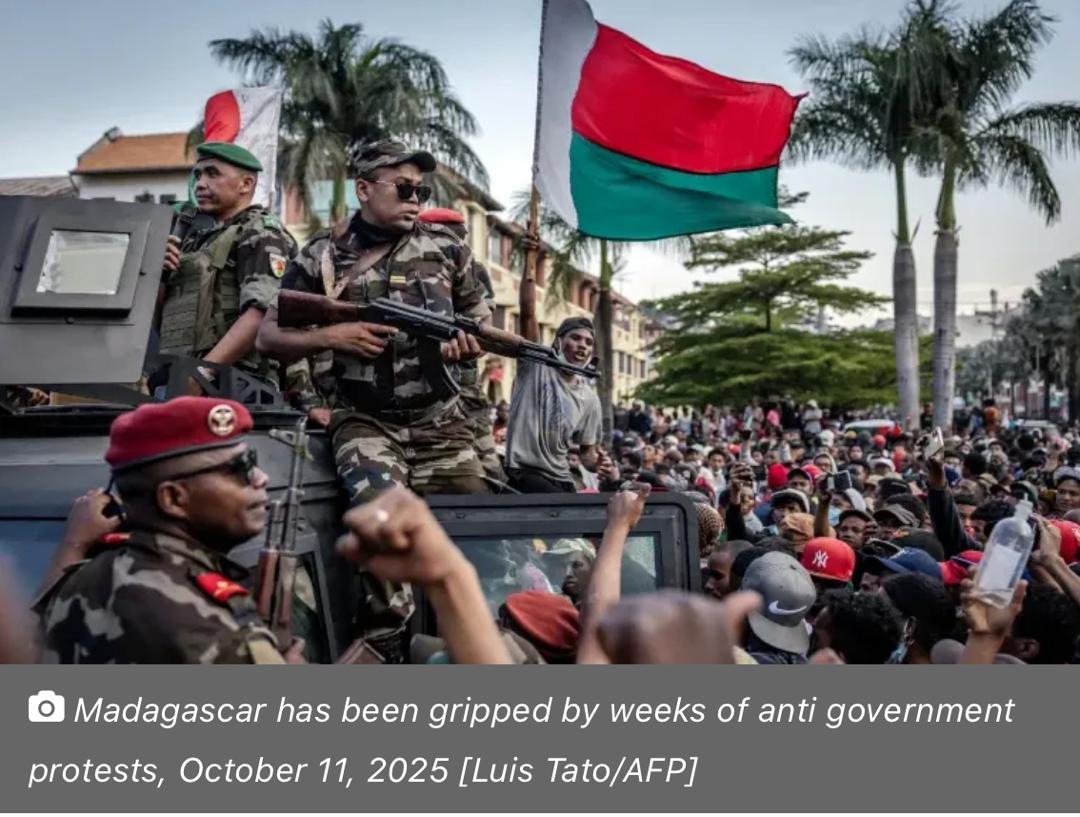
The elite CAPSAT army unit, which was instrumental in the 2009 coup that first brought Rajoelina to power, formed an alliance with the youth-led protesters on Saturday.
On Sunday morning, the contingent proclaimed in a video statement that “hereafter, all directives of the Malagasy army – whether land, air, or naval – will emanate from CAPSAT headquarters.”
Hours after the presidency accused unnamed forces of attempting to overthrow Rajoelina, the declaration was issued.
The presidency stated that “an attempted illegal and forcible seizure of power” was underway in the African nation, omitting details.
At the army ceremony in the capital, Pikulas admitted to journalists that recent events in Madagascar had been “unpredictable”.
“As a result, the army has a responsibility to restore calm and peace throughout Madagascar,” he remarked.
Regarding calls for Rajoelina to step down, he stated that he would not “discuss politics within a military facility”.
Military personnel from CAPSAT urged their comrades on Saturday to disobey orders and back the youth-led uprising instead.
According to certain unit members in a social media video, “We have become boot lickers.
We have chosen to submit and execute orders, even illegal ones, instead of protecting the population and their property.”
They further advised, “Do not obey orders from your superiors. Point your weapons at those who order you to fire on your comrades in arms because they will not take care of our families if we die.”
Colonel Michael Randrianirina of CAPSAT clarified that his unit’s decision to join the protesters did not constitute a coup, stating, “We answered the people’s calls, but it wasn’t a coup d’etat.”
According to Prime Minister Ruphin Fortunat Zafisambo, a military general appointed following Rajoelina’s dismissal of his predecessor amid protests, the government is “fully ready to engage in dialogue and listen to all factions – youth, unions, and the military”.
In a separate move, Madagascar’s Senate released a statement announcing the removal of Senate President General Richard Ravalomanana, a close ally of Rajoelina, citing “the current political situation in Madagascar and the Malagasy people’s aspirations for stability, justice, and transparent governance”.
Fahmida Miller, reporting for Al Jazeera from Antananarivo’s Independence Square on Sunday, observed that the announcement was well-received by the public.
“The people here consider the dismissal significant, as it could potentially lead to Andry Rajoelina’s ouster.
It is unclear, however, whether this is indeed the case or if the Senate is merely attempting to appease the protesting Malagasies,” she explained, pointing out that this, coupled with CAPSAT’s backing of the protesters, has generated a sense of hope among many.
“Madagascar is undoubtedly in crisis, but the locals remain optimistic about the possibility of change. They describe it as a revolution.
The people have given Andry Rajoelina a one-day deadline to vacate his office. They demand that he step down and issue an apology for the lives lost at the hands of security forces,” Miller noted.
Madagascar’s military has a long history of intervening in politics during times of crisis. Since gaining independence from France in 1960, it has supported or led several power shifts, including coups in the 1970s and in 2009, when it helped oust President Marc Ravalomanana and bring Antananarivo’s reformist mayor, Rajoelina, to power.
Although the military has remained largely in the background in recent years, it continues to be a significant force in the country’s often fragile political landscape.
Frustrated and angry,
the protests, which began in late September as rallies against chronic water and electricity shortages, have intensified into the gravest threat to Rajoelina’s authority since he won a disputed second term in 2023.
Madagascar’s electricity access is limited to approximately one-third of its population, according to the International Monetary Fund, with frequent blackouts lasting over eight hours daily.
Transparency International’s global vice chair, Ketakandriana Rafitoson, told Reuters that the consequences are severe, including inadequate refrigeration for medication and insufficient water for basic hygiene, further exacerbated by widespread corruption.
Recently, Rajoelina urged protesters to grant him a one-year extension, promising to step down if his final attempt to meet their expectations and regain public trust is unsuccessful.
According to Al Jazeera’s Miller, Malagasies have been left without a statement from their president for at least two days, resulting in widespread frustration and anger among the populace.
Protesters have vowed to continue their demonstrations for as long as President Andry Rajoelina remains in office, Miller added.
Security forces have repeatedly clashed with protesters, employing tear gas and rubber bullets. The United Nations has reported a death toll of at least 22 and over 100 injuries since the protests began on September 25, although the government contests these figures.
The declaration by CAPSAT unit members signaled a dramatic turn in the country’s weeklong political crisis. As the soldiers defected, they escorted thousands of protesters into May 13 Square, a symbolically significant site for political uprisings in Antananarivo that had been heavily guarded and sealed off for weeks.
Online videos depicted CAPSAT troops addressing crowds outside the capital’s town hall, with demonstrators and military personnel standing together atop a destroyed police vehicle.
The protesters, predominantly young people and university students, are demanding Rajoelina’s resignation, a national apology, and the dissolution of the Senate and electoral commission.
Organized under the Gen Z Madagascar banner, the protesters have rejected repeated government offers for talks, stating: “We do not engage with a regime that daily crushes those who stand up for justice.”
The movement, drawing inspiration from Nepal and Sri Lanka’s youth-led protests that toppled governments, has adopted a pirate skull and skull-and-crossbones image from the anime series One Piece.
Mahmoud Ali Youssouf, chairperson of the African Union Commission, expressed deep concern over Madagascar’s developments in a statement on Sunday, urging all parties to exercise calm and restraint.
Air France-KLM’s French division suspended flights between Paris-Charles de Gaulle Airport and Antananarivo from October 11 to October 13 due to the security situation, the airline stated on Sunday.
Video below 👇
https://www.tiktok.com/t/ZTMyeNEHL/
About the Author