
The Federal Government has reopened the First Niger Bridge, restoring vehicular movement between Onitsha in Anambra State and Asaba in Delta State following 38 days of closure for emergency maintenance and rehabilitation.
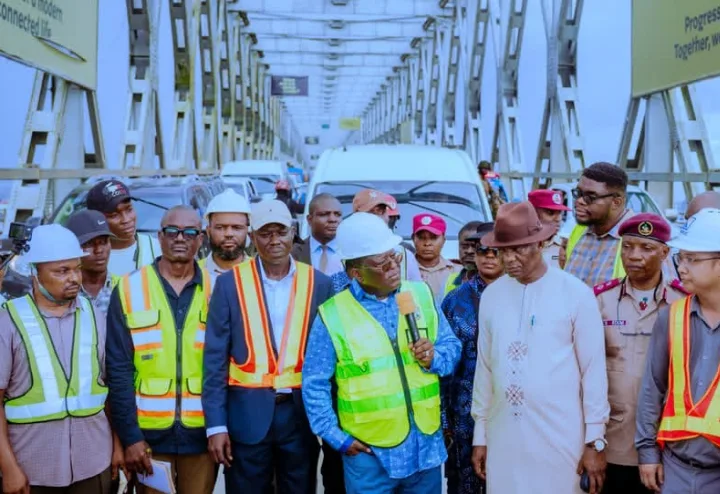
The Minister of Works, David Umahi, officially reopened the bridge on Thursday, October 15, 2026, at a ceremony attended by federal and state government representatives, traditional rulers and other stakeholders from the South-East and South-South regions.
The reopening followed extensive repair work intended to improve the condition of the ageing bridge, address vandalised structural components and strengthen safety measures for motorists using the critical transport route.
The bridge was initially scheduled to reopen on September 21, but persistent rainfall and delays in completing some aspects of the rehabilitation forced the government to extend the closure.
Why the Federal Government Closed the First Niger Bridge
The First Niger Bridge was closed to vehicular traffic on September 7, 2026, after inspections revealed damage to some of its structural components, including vandalised bolts and steelwork around the expansion joints.
These components are important to the bridge’s ability to accommodate movement caused by temperature changes, traffic loads and other structural stresses.
The discovery raised concerns about the bridge’s condition and the potential risks to motorists if the affected sections were not repaired before normal traffic resumed.
The Federal Ministry of Works subsequently initiated emergency maintenance and rehabilitation work to address the damage and improve the bridge’s overall condition.
Although the closure was initially expected to last approximately two weeks, persistent rainfall affected construction activities and delayed the completion of outstanding work.
The authorities maintained that the bridge would not be reopened until essential repairs had been completed and the necessary safety measures were in place.
Rehabilitation Includes CCTV Cameras, Solar Streetlights and Traffic Barriers
Beyond repairing damaged components, the Federal Government introduced additional safety and traffic-management measures as part of the rehabilitation exercise.
According to the Minister of Works, the intervention included resurfacing sections of the bridge, installing solar-powered streetlights and introducing closed-circuit television cameras to strengthen surveillance.
A median barrier was also installed to improve traffic discipline and discourage dangerous driving.
Three designated turnaround points were created to help motorists and emergency responders manage situations involving vehicle breakdowns and other incidents on the bridge.
The government also announced plans to establish security monitoring centres at both ends of the bridge. These facilities are intended to support surveillance and improve the monitoring of activities around the structure.
The new installations are particularly significant because the bridge serves a busy corridor used by private motorists, commercial vehicles, traders and commuters travelling between the South-East and South-South.
However, the long-term effectiveness of these measures will depend on proper maintenance, enforcement of traffic rules and regular inspection of the bridge’s structural components.
Persistent Rainfall Delayed the Reopening
The reopening did not take place as originally planned.
When the bridge was closed in September, the Federal Government announced that the rehabilitation period would run from September 7 to September 21.
However, heavy and persistent rainfall disrupted construction activities and affected some sections of the ongoing work.
In September, the Acting Federal Controller of Works in Anambra State, Timothy Emenike, explained that the weather had made it difficult to complete the remaining rehabilitation activities.
The Minister of Works subsequently inspected the project and maintained that the bridge would not be reopened until the major structural work had been completed.
By October, officials reported that critical repairs, including work on the expansion joints and road surface, had been completed, while other finishing activities continued.
The bridge was eventually reopened on October 15, bringing the extended closure to an end.
How the Closure Affected Motorists and Businesses
The First Niger Bridge is a major transport link between Onitsha, one of Nigeria’s important commercial centres, and Asaba, the capital of Delta State.
Its closure forced motorists to rely on the Second Niger Bridge and alternative routes, increasing journey times and transportation costs for many commuters and businesses.
Commercial drivers, traders and transport operators were among those affected by the disruption, particularly those whose daily activities depend on movement between Anambra, Delta and neighbouring states.
Onitsha’s commercial importance means that delays along the corridor can affect the movement of goods and the cost of transporting merchandise.
For commuters, the closure also created additional travel challenges, especially for people who regularly cross between the two states for work, education, healthcare and other personal activities.
With the First Niger Bridge now reopened, motorists can once again use the route, potentially easing pressure on alternative roads and improving movement between the two regions.
Nevertheless, the extent of the relief will depend on traffic conditions, compliance with the new traffic arrangements and the proper management of heavy vehicles.
Umahi Raises Concerns Over Activities Near the Bridge
During the reopening, Umahi also raised concerns about activities that could threaten the safety and durability of the bridge.
One issue highlighted by the minister was alleged sand dredging near the structure. He warned that federal regulations prohibit such activities within a 10-kilometre radius of federal bridges.
The minister directed relevant officials in Delta and Anambra states to ensure that the restriction was enforced.
Activities that alter riverbeds or undermine areas around bridge foundations can raise serious engineering and environmental concerns. Consequently, enforcement and monitoring around the bridge will remain important beyond the immediate rehabilitation exercise.
The government has also emphasised the need to protect the structure against vandalism, excessive loading and poor maintenance practices.
The successful completion of repairs is only one part of the process. Preventing future damage will require continuous inspections, effective security arrangements and timely maintenance.
Federal Government Outlines Additional Road Projects
The reopening ceremony also provided an opportunity for Umahi to discuss other road infrastructure projects in the region.
The minister ordered a comprehensive redesign of the Benin-Asaba Expressway before its reconstruction, citing concerns about the road’s deteriorating condition.
He also disclosed that the Federal Government had terminated a remedial contract covering the first 11 kilometres of the highway because of concerns about the quality of the work.
According to the minister, a revised approach is intended to provide more durable results for motorists using the route.
Umahi further announced plans to reconstruct approximately 400 kilometres of the East-West Road, which he described as a spur of the Lagos-Calabar Coastal Highway project.
Other projects mentioned included sections of the Enugu-Onitsha Expressway and the bypass associated with the Second Niger Bridge.
These projects are important to regional connectivity because the South-East and South-South depend heavily on road transport for commerce, agriculture, manufacturing and the movement of people.
However, the practical benefits of the proposed interventions will depend on funding, implementation timelines, construction quality and effective project supervision.
Delta Government and Traditional Rulers Welcome the Reopening
Delta State Governor Sheriff Oborevwori commended the Federal Government for responding to concerns surrounding the safety of the First Niger Bridge.
Represented at the event by the Commissioner for Works (Rural Roads) and Public Information, Charles Aniagwu, the governor stressed the importance of developing a consistent maintenance culture to prevent public infrastructure from deteriorating before intervention becomes necessary.
Oborevwori also acknowledged the minister’s repeated visits to the bridge during the rehabilitation period.
The Asagba of Asaba, Epiphany Azinge, also welcomed the intervention, describing the rehabilitation as an important step towards strengthening the bridge and extending its service life.
The traditional ruler noted that the bridge remains central to economic and social relationships between Delta and Anambra states and the wider South-East and South-South regions.
He also urged the government to accelerate other important road projects, particularly the reconstruction of the Benin-Asaba Expressway.
First Niger Bridge: A Major Link in Nigeria’s Transport Network
The First Niger Bridge was completed in 1965 and has served generations of Nigerians travelling between the eastern and western banks of the River Niger.
The bridge connects Onitsha in Anambra State with Asaba in Delta State, providing an important route for commercial activities and regional travel.
As the structure has aged, maintaining its safety and functionality has become increasingly important.
The Second Niger Bridge was developed to provide additional capacity and reduce pressure on the older crossing. It was completed and commissioned in 2023.
Although the newer bridge offers an alternative route, the First Niger Bridge remains a significant part of the region’s transport network.
Its continued availability is therefore important not only for individual motorists but also for businesses, logistics operators and communities that depend on reliable movement between the two states.
About the Author