
Masked Israeli settlers reportedly attacked European diplomats, Palestinian civilians and Catholic representatives in the occupied West Bank on Saturday, October 17, 2026, prompting diplomatic condemnation and an Israeli police investigation. The incident occurred in Taybeh, a predominantly Christian Palestinian village, during the annual olive harvest, a vital agricultural season for many Palestinian families.
Belgian Foreign Minister Maxime Prévot said the delegation included Belgium’s consul general to the Palestinians, French and Polish diplomatic representatives, and Catholic figures. A French mayor was reportedly assaulted, while a vehicle belonging to the Belgian delegation sustained damage.
The attack came amid escalating reports of violence against Palestinian farmers and others during the olive harvest. It also followed a separate assault on Friday in which Washington Post photojournalist Heidi Levine was seriously injured while covering attacks on Palestinian olive harvesters.
The developments have renewed calls for stronger protection for Palestinian civilians, journalists, humanitarian representatives and foreign diplomats operating in the occupied territory. Israeli authorities condemned the reported violence and said investigations were underway, although the circumstances and individual responsibility for the incident remained under investigation as of October 17.
European Diplomats Targeted in Taybeh
According to statements from Belgian officials and reports from international news organisations, the incident occurred near the Palestinian Christian village of Taybeh in the central occupied West Bank.
The delegation included representatives from Belgium, France and Poland who were visiting the area alongside other officials and Catholic representatives. Their presence coincided with activities connected to the olive harvest and solidarity with the local Palestinian community.
Belgian Foreign Minister Maxime Prévot publicly condemned the reported attack, confirming that Belgium’s consul general, French and Polish diplomats, and Catholic representatives had been among those targeted.
Prévot also reported that a French mayor was assaulted and that a Belgian vehicle was damaged. He said the Belgian team was safe.
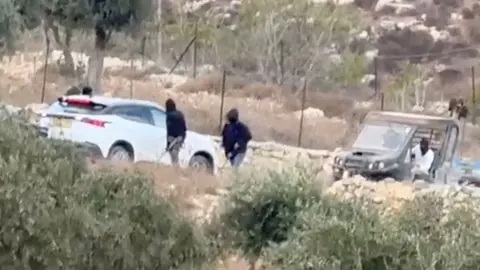
Footage shared by activists reportedly showed masked individuals approaching a diplomatic vehicle, demanding identification from those inside and moving towards the group while carrying sticks. Other images showed a person sitting on the ground beside a vehicle.
An activist who was present, Amit Orfali, said the masked men had threatened to kill those at the scene, according to reporting by The Associated Press.
The precise sequence of events and the identities of those responsible had not been conclusively established in the initial reports. Israeli police said they were investigating footage of the incident and working to identify suspects.
French Mayor Says He Was Thrown to the Ground
One of the most striking accounts came from Bernard Baudoux, a 78-year-old French mayor who was visiting the area in solidarity with Palestinian olive farmers.
Baudoux, mayor of Aulnoye-Aymeries in northern France, told Reuters that masked settlers had violently attacked him while he was participating in the olive harvest near Taybeh.
“I was thrown to the ground,” he said, describing the incident in an interview with the news agency.
Reports indicated that Baudoux had joined the visit to demonstrate solidarity with the Palestinian community during a period of heightened tensions surrounding the harvest.
Other reporting said the mayor was kicked and struck with iron bars. He reportedly suffered minor injuries, although the attack left him concerned about the situation facing local residents.
The presence of a visiting European municipal official alongside diplomatic representatives has added an international dimension to the incident. Diplomats and elected officials generally undertake field visits to observe conditions, maintain contacts with local communities and assess developments affecting civilian life.
An attack on such a delegation, if established by the investigation, raises serious concerns about the safety of diplomatic engagement and the protection of people carrying out official or humanitarian activities.
Belgium Calls for Accountability and Possible EU Sanctions
Belgium responded forcefully to the incident, with Prévot demanding protection for Palestinians and accountability for those responsible for violence.
The Belgian foreign minister argued that Israeli authorities, as the occupying power, had a responsibility to protect Palestinians and ensure the safety of diplomats and journalists.
He also linked the incident to Israel’s settlement policy in the occupied West Bank and said Belgium would push for additional European Union sanctions against those responsible for the violence and those supporting them.
Belgium has previously announced restrictions on imports from Israeli settlements in the West Bank and the Golan Heights. The latest incident could intensify discussions within Europe over additional measures, although any new EU action would depend on political and diplomatic decisions among member states.
Prévot’s response reflected a broader concern among European officials about recurring attacks on Palestinians and the risks faced by international observers working in the territory.
The incident also places pressure on Israeli authorities to demonstrate that investigations into attacks by settlers can lead to meaningful accountability.
For European governments, the safety of their diplomatic personnel is a direct concern. However, the broader diplomatic response is also tied to the security of Palestinian communities, access to farmland and the ability of journalists and observers to document events without intimidation.
Israel Condemns the Violence but Questions Coordination of the Visit
Israeli officials also responded to the incident, although their statements included questions about the delegation’s arrangements.
Israeli Foreign Minister Gideon Saar condemned what he described as serious violence by Israeli rioters in the Taybeh area. He said his ministry was in contact with ambassadors from the countries concerned.
The Israeli military also condemned the incident, describing it as a severe act of violence involving diplomatic representatives. However, the military said the visit had not been coordinated with it and that no soldiers were present at the scene when the attack occurred.
The military said police officers would enter the area with military escort to collect evidence and take testimony as part of the investigation.
Israeli police separately confirmed that an investigation had been opened after footage of the incident emerged. Authorities said the investigation would seek to identify the people involved and establish the circumstances surrounding the confrontation.
Prime Minister Benjamin Netanyahu’s office urged caution before drawing conclusions, noting that the investigation was ongoing. It argued that the available images did not, by themselves, establish the complete sequence of events or individual responsibility and raised concerns about what it described as a coordinated campaign to discredit Israel and Jewish residents of the West Bank.
These statements illustrate the competing positions emerging after the incident. Belgian officials and witnesses described an assault on diplomats and other visitors, while Israeli authorities said the evidence and circumstances required investigation. The police inquiry is therefore central to establishing responsibility and determining whether charges should follow.
Palestinian Officials Condemn the Attack
Palestinian officials also condemned the reported violence.
Palestinian Vice President Hussein al-Sheikh denounced the incident, describing it as an example of the wider violence Palestinians face in the occupied West Bank.
For Palestinian communities, attacks during the olive harvest carry consequences beyond immediate physical injuries. Olive farming is a source of household income, employment and cultural identity, particularly in rural areas where families depend on access to trees and agricultural land passed down through generations.
When farmers are threatened, assaulted or prevented from reaching their groves, the consequences can include lost income, damaged crops and increased uncertainty about future harvests.
The reported attack on the diplomatic delegation has drawn attention to the risks faced by local residents as well as international visitors. Diplomats and foreign observers may be able to leave the area after a visit, while Palestinian farmers must continue living and working amid the conditions being documented.
Local representatives have repeatedly called for safer access to agricultural land and stronger measures to prevent attacks on residents.
Olive Harvest Season Marked by Rising Violence
The olive harvest is one of the most important periods in the Palestinian agricultural calendar. It provides income for thousands of families and plays a central role in rural economic and cultural life.
However, the 2026 harvest has been accompanied by reports of attacks, injuries and damage to property in several parts of the occupied West Bank.
According to figures cited by The Associated Press from the Palestinian Health Ministry, at least four people had been killed and more than 100 injured since the harvest began earlier in October. These figures relate to the wider period of harvest-related violence, not solely to the incident involving European diplomats.
Reports have described attacks involving masked individuals, stones, sticks and other weapons. Palestinian farmers and activists have also reported interference with access to olive groves and damage to trees.
The violence has raised concerns among human rights advocates and international observers about whether sufficient protection is being provided to Palestinian communities during the harvest.
For many families, the annual collection of olives is not simply a seasonal activity. It is a major source of livelihood and a longstanding connection to ancestral land. Disruption of the harvest can affect household finances long after the immediate confrontation ends.
The attacks have also placed pressure on Israeli security forces to respond more effectively to allegations of violence by settlers and to ensure that those responsible are investigated.
Washington Post Photographer Injured in Separate Attack
The attack on the European delegation came one day after Washington Post photojournalist Heidi Levine was injured while covering violence against Palestinian olive harvesters near Abu Falah in the West Bank.
According to Reuters and The Washington Post, Levine was assaulted by masked settlers on Friday, October 16, while reporting on the harvest. She was wearing protective equipment identifying her as a member of the press.
Reports said she was knocked to the ground, kicked and beaten. She was subsequently taken to hospital with injuries that included a broken rib and a serious hand injury requiring surgery.
Other people were also reported injured during the Friday violence, which involved attacks on Palestinian harvesters and damage to olive trees.
The Washington Post called for an investigation into the assault on its photographer. The incident has raised concerns about the ability of journalists to document violence safely, particularly when reporting from isolated rural locations.
The two incidents, occurring on consecutive days, have intensified scrutiny of the security environment facing Palestinians, international diplomats and members of the media during the harvest.
Journalists play an important role in documenting events and providing independent information to the public. Attacks on reporters can prevent evidence from reaching the public and discourage further coverage of sensitive situations.
The Wider Conflict Over Settlements in the West Bank
The attack has also revived attention to the longstanding dispute over Israeli settlements in the occupied West Bank.
Israel captured the West Bank, including East Jerusalem, during the 1967 Middle East war. Palestinians seek the territory as part of a future independent state.
The United Nations and much of the international community consider Israeli settlements in the occupied West Bank illegal under international law. Israel disputes aspects of this position and raises historical, security and legal arguments concerning the territory.
Over the years, Israeli settlements have expanded, while Palestinian communities have faced disputes over land, movement, construction and access to agricultural areas.
Human rights organisations and Palestinian residents have documented recurring allegations of settler violence, including assaults, threats, destruction of property and interference with farming. Israeli officials have periodically condemned such attacks, with some describing the perpetrators as a minority of violent individuals.
Critics argue that investigations and prosecutions have often failed to provide sufficient deterrence. Israeli authorities say allegations of criminal conduct should be investigated and that those responsible should face justice.
The incident in Taybeh has brought these wider questions back into focus because the reported targets included not only Palestinian civilians but also representatives of European governments.
Why the Incident Matters Internationally
The reported assault has implications beyond the immediate area where it occurred.
First, it raises questions about diplomatic security. European representatives must be able to visit communities and carry out official duties without being subjected to violence or intimidation.
Second, it highlights the vulnerability of Palestinian farmers during a crucial agricultural season. The ability to reach farmland safely can determine whether families are able to harvest their crops and earn their expected income.
Third, it raises concerns about press freedom and independent reporting. The separate assault on Levine demonstrates the risks faced by journalists documenting events on the ground.
Finally, the incident could contribute to further diplomatic pressure on Israel. Belgium’s call for additional EU sanctions suggests that governments may seek consequences beyond public condemnation if responsibility is established and violence continues.
Whether the incident results in arrests, prosecutions or additional diplomatic measures will depend on the findings of the investigation and subsequent decisions by national and European authorities.
What Happens Next?
Israeli police have opened an investigation into the reported attack and said they would work to identify those involved. The Israeli military has also said evidence and testimony would be collected.
The next steps will include clarifying the sequence of events, identifying suspects, obtaining statements from those present and determining whether criminal charges are warranted.
European governments are expected to seek answers about the safety of their diplomatic representatives and the circumstances surrounding the incident. Belgium has already indicated that it intends to pursue additional EU sanctions against those responsible for the violence and those who support it.
Meanwhile, Palestinian farmers continue to face the practical challenge of completing the olive harvest while dealing with reports of threats and attacks.
The situation remains sensitive, and further developments could affect diplomatic relations, public debate over settler violence and the broader international response to conditions in the occupied West Bank.
The reported attack on European diplomats in Taybeh has intensified international concern over violence during the Palestinian olive harvest. While Israeli authorities have condemned the incident and launched an investigation, the key questions now concern accountability, the protection of Palestinian communities and whether diplomatic pressure will lead to stronger measures to prevent further attacks.
About the Author