
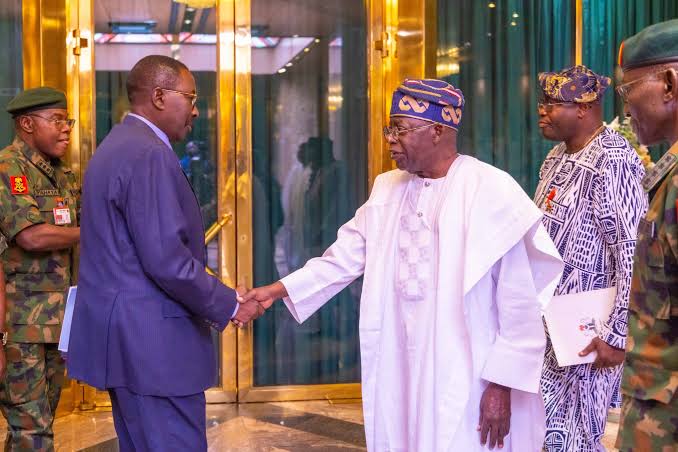
President Bola Ahmed Tinubu has met with Nigeria’s Chief of Defence Staff (CDS), service chiefs and heads of security agencies to review the country’s security situation and strengthen preparations for the 2027 general elections.
The meeting, held at the Presidential Villa in Abuja on Thursday, October 15, 2026, lasted approximately five hours and focused on ensuring that Nigerians can participate in the forthcoming elections without fear of violence, intimidation or other security threats.
According to Defence Minister General Christopher Musa (retd.), the President directed security agencies to work towards providing a safe environment for voters and ensuring that the elections are free, fair and credible.
Tinubu also issued a fresh directive for security agencies to intensify efforts to locate and rescue Nigerians held by kidnappers and other criminal groups across the country.
The meeting brought together senior military officers, intelligence officials and government representatives responsible for national defence, internal security and policing.
Tinubu Demands Free, Fair and Credible Elections
Speaking to journalists after the meeting, Musa said the President made it clear that the government expected security agencies to provide the conditions necessary for credible elections.
The defence minister explained that the gathering was convened to brief Tinubu on developments in the country’s security situation as preparations for the 2027 polls continue.
He said the President emphasised the importance of ensuring that citizens could exercise their voting rights without intimidation.
Musa also assured Nigerians that the military would remain politically neutral during the electoral process.
According to the minister, security agencies would not take sides with political parties or candidates, adding that every eligible participant should have an equal opportunity to contest and seek public office.
He urged Nigerians to come out and vote for candidates of their choice, stressing that security personnel would be expected to protect the electoral process rather than influence political outcomes.
The assurance comes as political parties and prospective candidates prepare for the next general elections, which will determine the country’s political leadership at federal and state levels.
The effectiveness of the commitment will depend on how security personnel conduct themselves before, during and after the elections, particularly in areas where political tensions or existing security challenges could disrupt voting.
Who Attended the Presidential Security Meeting?
The meeting was attended by key officials responsible for Nigeria’s defence, intelligence gathering, policing and national security coordination.
Those present included:
- President Bola Ahmed Tinubu: Presided over the meeting and issued directives concerning election security and the rescue of abducted citizens.
- General Christopher Musa (retd.), Minister of Defence: Briefed journalists after the meeting and communicated the President’s instructions to security agencies.
- Nuhu Ribadu, National Security Adviser (NSA): Responsible for coordinating national security policy and advising the President on security matters.
- Ibrahim Gaidam, Minister of Police Affairs: Attended as part of the government’s representation on policing and internal security.
- Bello Matawalle, Minister of State for Defence: Participated in discussions concerning defence and military operations.
- General Olufemi Oluyede, Chief of Defence Staff: Attended alongside the service chiefs to represent the Armed Forces leadership.
- Lieutenant General Waidi Shaibu, Chief of Army Staff: Represented the Nigerian Army.
- Vice Admiral Idi Abbas, Chief of Naval Staff: Represented the Nigerian Navy.
- Air Marshal Sunday Aneke, Chief of Air Staff: Represented the Nigerian Air Force.
- Lieutenant General Emmanuel Undiandeye, Chief of Defence Intelligence: Represented the military intelligence establishment.
- Olatunji Disu, Inspector-General of Police (IGP): Attended as the head of the Nigeria Police Force.
- Mohammed Mohammed, Director-General of the National Intelligence Agency (NIA): Represented the foreign intelligence agency.
- Adeola Oluwatosin Ajayi, Director-General of the Department of State Services (DSS): Represented the domestic intelligence and security agency.
- Major-General Adeyinka Famadewa (retd.), Special Adviser to the President on Homeland Security: Participated in the discussions on national security.
The presence of these officials brought together the country’s principal military, intelligence and policing institutions for discussions on electoral preparations and wider security concerns.
January 2027 Elections in Focus
The meeting comes approximately three months before Nigerians are scheduled to begin voting in the 2027 general elections.
According to the election timetable reported by Channels Television, the presidential and National Assembly elections are scheduled for January 16, 2027, while governorship and state House of Assembly elections are scheduled for February 6, 2027.
The approaching elections require coordination among electoral authorities, security agencies, political parties and other stakeholders.
Security preparations are particularly important in areas experiencing terrorism, banditry, kidnapping, communal violence or other criminal activities that could prevent voters from reaching polling units.
The presence of security personnel around election venues can help protect voters, electoral officials, ballot materials and collation centres. However, their deployment must also comply with the law and respect citizens’ rights.
The authorities will therefore face the dual responsibility of preventing violence and ensuring that security arrangements do not interfere with lawful political participation.
Musa’s statement that security agencies would remain neutral addresses one of the central expectations of an electoral process: that citizens should be able to vote freely and that political actors should not face intimidation from those assigned to maintain order.
Tinubu Orders Rescue of Kidnap Victims Nationwide
Beyond preparations for the elections, the meeting also addressed the continuing problem of kidnapping and insecurity across Nigeria.
Musa disclosed that Tinubu directed security agencies to intensify operations to locate and rescue people who had been kidnapped or abducted in different parts of the country.
The President’s instruction, as conveyed by the defence minister, was for the agencies to make every effort to find those being held captive and dismantle terrorist and bandit camps.
The directive places renewed emphasis on rescue operations and efforts to disrupt criminal groups responsible for abductions and attacks.
Kidnapping remains a serious concern for communities, families, commuters and businesses in parts of the country. Attacks on rural settlements, highways and other vulnerable locations have also contributed to demands for stronger security operations.
However, the practical outcome of the directive will depend on intelligence gathering, coordination among security agencies, operational resources and the ability to protect communities after criminal groups have been displaced.
Musa urged Nigerians to cooperate with security agencies and report suspicious activities or misconduct by security personnel.
He stressed that maintaining security was a shared responsibility and not solely the duty of the armed forces or police.
The minister also rejected allegations that the Nigerian military recruits underage personnel for its operations. He argued that reports concerning the use of children in armed activities related to terrorist groups, rather than official military recruitment.
Tinubu to Inaugurate 10 Aircraft and Helicopters
Musa also disclosed that Tinubu would soon inaugurate approximately 10 newly acquired aircraft and helicopters intended to strengthen Nigeria’s aerial surveillance and security capabilities.
According to the minister, the planned inauguration would demonstrate the administration’s continued attention to security despite the country’s wider economic challenges.
Aircraft and helicopters can support military and security operations through surveillance, reconnaissance, troop movement, logistics and other missions, depending on their specifications and operational roles.
Improved aerial capabilities may also assist security agencies in monitoring difficult terrain and supporting operations against armed groups.
However, the actual contribution of the new equipment will depend on factors such as availability, maintenance, trained personnel, operational coordination and the specific capabilities of the aircraft.
The minister did not provide a complete list of the aircraft and helicopters during his post-meeting remarks. Their individual specifications, deployment locations and operational schedules were also not fully detailed in the public briefing.
The planned inauguration is therefore a development to watch as the government continues its efforts to improve the country’s security response.
Government Considers Welfare of Security Personnel
Musa also discussed the welfare of members of Nigeria’s security services.
He said the President intended to extend the new salary structure to police officers, other paramilitary personnel and pensioners.
The minister referred to recent salary increases for members of the Armed Forces and said other categories of personnel were also being considered.
Improved welfare can form part of broader efforts to support recruitment, retention and morale among personnel responsible for national security.
However, the details of any proposed adjustments for police officers, paramilitary workers and pensioners, including their implementation dates and applicable rates, were not fully specified in the minister’s remarks.
The issue is particularly relevant as security agencies are expected to undertake extensive duties during the election period while continuing routine operations against criminal groups.
What the Meeting Means for Nigeria’s 2027 Elections
The presidential meeting signals that election security has become a central item on the government’s national security agenda ahead of the 2027 polls.
For voters, the key issue will be whether the assurances made by the government translate into practical arrangements that allow people to register, travel to polling units, vote and leave safely.
Political parties will also be watching how security agencies handle rallies, campaign events, disputes and complaints involving supporters of different candidates.
The commitment to neutrality will require consistent conduct by security personnel across states and electoral locations. It will also require clear communication among security agencies and cooperation with the Independent National Electoral Commission (INEC).
At the same time, security operations against kidnappers, terrorists and bandits will remain important to the wider environment in which the elections take place.
The government has outlined its expectations, but the public assessment of those commitments will ultimately depend on implementation and the conduct of the agencies involved.
As the election dates approach, Nigerians will be looking for further details on deployment plans, emergency response arrangements, protection of electoral materials and measures to prevent political violence.
About the Author