
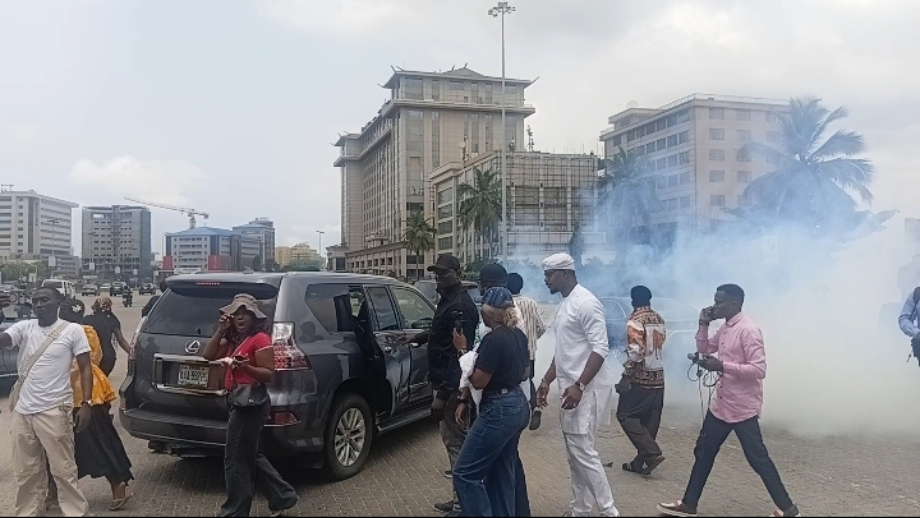
Police officers on Tuesday, October 20, 2026, dispersed a memorial gathering at the Lekki Toll Gate in Lagos State, firing tear gas at participants who had assembled to honour victims of the 2020 #EndSARS protests. The operation disrupted a planned wreath-laying ceremony and renewed concerns about freedom of assembly, police conduct and the continuing demand for justice six years after the demonstrations.
The gathering was organised by the Enough is Enough (EiE) movement as part of activities marking the sixth anniversary of the nationwide protests against police brutality, extortion, unlawful arrests and alleged extrajudicial killings attributed to officers of the now-disbanded Special Anti-Robbery Squad (SARS).
Residents, journalists, activists and political figures had converged on the tollgate to remember people who died or went missing during the protests and to renew calls for accountability over the events of October 2020.
However, the commemoration was cut short when police officers deployed to the location fired tear gas canisters, forcing participants to scramble for safety before the planned ceremony could proceed as intended.
Political figures caught up in the dispersal
Among those present at the memorial were Gbadebo Rhodes-Vivour, the Lagos State governorship candidate of the African Democratic Congress (ADC), and Funso Doherty, a governorship candidate of the Nigeria Democratic Congress (NDC).
Both politicians had joined other participants at the tollgate to honour the victims of the protests. Reports from the scene said the gathering was disrupted before the planned wreath-laying could be completed.
Videos circulated by news organisations showed participants moving away from the area as tear gas spread through the gathering.
The presence of political figures, residents and journalists highlighted the public significance of the anniversary and the continuing sensitivity surrounding memorial events at the tollgate.
The Enough is Enough movement had planned the gathering to provide an opportunity for Nigerians to remember those affected by the 2020 protests. The ceremony was also intended to keep public attention on the demands for justice, police accountability and institutional reform that helped drive the #EndSARS movement.
The dispersal prevented the event from proceeding as planned and brought renewed attention to the relationship between the authorities and citizens seeking to commemorate the protests.
Why police restricted the anniversary gathering
The Lagos State Police Command had warned ahead of the anniversary that street demonstrations would not be permitted as part of the commemorative activities. According to reports, the command said indoor and virtual events would be allowed instead.
The police cited intelligence reports indicating the possibility of clashes involving opposing groups as part of the reason for the restriction.
Reports also described a substantial police presence at the tollgate, with approximately 30 police trucks and armed personnel deployed to enforce the directive.
The security deployment formed the backdrop to Tuesday’s confrontation, as participants arrived for the memorial and attempted to commemorate the victims.
Although maintaining public order is a responsibility of law-enforcement agencies, the incident raises questions about how authorities balance security concerns with the right of citizens to gather peacefully.
The use of tear gas to disperse a memorial gathering is likely to intensify public debate over whether less forceful measures could have been used and whether restrictions on public assemblies are proportionate to the risks cited by the authorities.
As of the reports available on October 21, the coverage did not establish that the police had announced a comprehensive public account of the operation or disclosed the full circumstances surrounding the decision to disperse the gathering.
Organisers planned wreaths for victims
The memorial organisers had scheduled a wreath-laying ceremony for 11 a.m. to honour people who died or went missing in connection with the 2020 protests.
According to Premium Times, the plan involved 15 wreaths: nine for people listed as dead in connection with the Lekki incident, four for people listed as missing and presumed dead, one for journalist Pelumi Onifade, and another for other unidentified victims.
The ceremony was intended to offer a moment of remembrance for families and supporters who continue to seek answers about the fate of victims and the circumstances surrounding the violence.
However, the police intervention disrupted the gathering before the programme could be completed.
The planned wreath-laying was more than a symbolic gesture for the organisers. It represented an effort to keep the victims’ experiences in public memory and to remind authorities that questions surrounding the protests have not disappeared with the passage of time.
For families of people who died or disappeared, anniversary events can also provide opportunities to call for investigations, compensation and the release of information that may help establish what happened to their loved ones.
The disruption therefore extended beyond the cancellation of a public ceremony, touching on the broader debate about how Nigerians can commemorate contested historical events and demand accountability.
Six years after the #EndSARS protests
The #EndSARS movement gained nationwide momentum in October 2020 after Nigerians mobilised against alleged abuses by SARS, a police unit that had been repeatedly accused of harassment, extortion, torture and unlawful killings.
Young people led demonstrations across several cities, using public gatherings and social media campaigns to demand the unit’s disbandment and broader changes to policing.
On October 11, 2020, the Federal Government announced that SARS would be disbanded. However, demonstrations continued as protesters demanded more than the announcement, including accountability for officers accused of abuses, compensation for victims and comprehensive police reform.
The Lekki Toll Gate became one of the movement’s most prominent locations because demonstrators gathered there during the protests and because of the violence reported at the site on October 20, 2020.
The events of that night became a defining moment in the movement and generated national and international scrutiny.
Amnesty International reported that security forces killed protesters during the wider crackdown on demonstrations in Lagos. The Lagos State Judicial Panel of Inquiry subsequently investigated the Lekki incident and made findings concerning the actions of security personnel, casualties and injuries.
Disagreements over aspects of the incident, the official interpretation of the evidence and the adequacy of the response have continued to fuel calls for further accountability.
For many activists, the anniversary remains a reminder that disbanding SARS did not, by itself, settle all the questions about police conduct or guarantee that the abuses associated with the unit would end.
Rights groups renew calls for accountability
The latest dispersal occurred as civil society organisations renewed demands for justice for victims of police abuses and implementation of recommendations arising from investigations into the Lekki incident.
The Rule of Law and Accountability Advocacy Centre (RULAAC) argued that the disbandment of SARS had not ended allegations of police brutality, torture, extortion, unlawful detention and extrajudicial killings.
The organisation called for the enforcement of the Police Act 2020 and the Anti-Torture Act 2017. It also urged authorities to investigate allegations of misconduct, prosecute officers found culpable and strengthen civilian oversight of the police.
Corporate Accountability and Public Participation Africa (CAPPA) also called on the Federal Government and Lagos State Government to apologise for the Lekki shootings and provide redress for victims.
CAPPA urged the authorities to conduct independent investigations, prosecute those found responsible and compensate people killed or injured during the crackdown.
The organisation also called for the preservation of the Lekki Toll Gate as a national memorial and advocated additional safeguards, including the use of body-worn cameras by police officers.
These demands reflect a wider debate about how to prevent future abuses and ensure that allegations against security personnel are investigated transparently.
The organisations’ statements represent civil society positions and demands; any criminal responsibility must be established through appropriate investigative and judicial processes.
Previous court ruling on an #EndSARS memorial
The latest incident also recalls earlier confrontations between police officers and people who gathered at the tollgate to mark the anniversary.
In July 2025, the Federal High Court in Lagos ordered the Inspector-General of Police and the then Lagos State Commissioner of Police, Moshood Jimoh, to jointly pay ₦10 million in damages to protesters whose rights were violated during a memorial procession at the tollgate on October 20, 2024.
According to Premium Times, the judge held that the arrests violated the applicants’ constitutional rights to peaceful assembly and association. The applicants had alleged that officers used tear gas and live ammunition, assaulted participants and detained them before releasing them without charge.
The court also ruled that an earlier Lagos State High Court order restricting protests to designated parks could not be applied retrospectively to the gathering.
The case involved 22 individuals and three organisations: the Education Rights Campaign, Take It Back Movement and Campaign for the Defence of Human Rights.
That ruling is relevant to the continuing debate over the policing of anniversary gatherings. It demonstrates that restrictions and enforcement actions can be challenged in court and that the legality of police conduct depends on the circumstances and applicable law.
However, the 2025 judgment concerned an earlier event. It should not be treated as a judicial determination of the legality of the police action taken during the October 20, 2026 memorial. Any legal assessment of the latest incident would require consideration of its own facts and any proceedings that may follow.
What the incident means for police reform
The dispersal of the memorial has once again placed police accountability and the right to peaceful assembly at the centre of public discussion.
The authorities face the challenge of maintaining public safety while respecting the constitutional rights of citizens. When police use force to disperse a gathering, questions arise about the intelligence behind the operation, the threat perceived by officers, the necessity of the force used and whether less intrusive alternatives were available.
Tear gas can cause breathing difficulties, eye irritation and disorientation, particularly in crowded spaces. Its deployment can also create risks when participants rush away from an area without clear escape routes.
Transparent communication from the police, including an explanation of the operational decision and any review of complaints, would help the public understand the incident and assess whether the response was justified.
At the same time, the continued calls for justice six years after the protests underline the importance of credible investigations, appropriate remedies for victims and meaningful reform of police accountability mechanisms.
The anniversary also shows how the Lekki Toll Gate has become a site of public memory, where debates about policing, governance, civil liberties and the treatment of young Nigerians converge.
The police dispersal of the #EndSARS memorial at Lekki Toll Gate has renewed debate about the right to peaceful assembly and the continuing struggle for accountability over the October 2020 protests.
The gathering, organised by the Enough is Enough movement, was intended to honour those who died or went missing and to renew calls for police reform. But the deployment of tear gas prevented the planned commemoration from proceeding as intended.
Six years after the protests, the questions surrounding the Lekki incident remain deeply significant for victims’ families, activists and many Nigerians seeking justice.
The latest episode highlights the need for transparent explanations of police actions, respect for lawful public gatherings and credible processes for investigating allegations of abuse.
The central issue is no longer only how the 2020 protests are remembered, but whether the lessons drawn from them will lead to lasting improvements in policing, accountability and the protection of citizens’ rights.
About the Author