

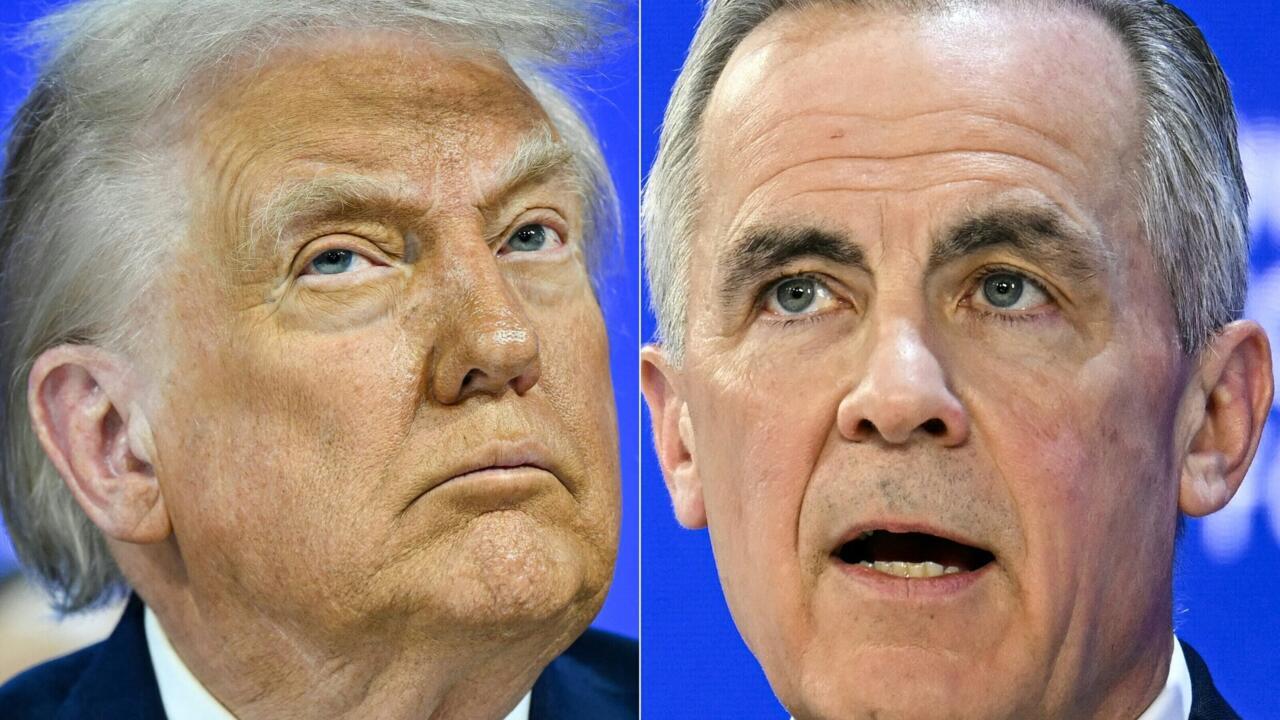
U.S. President Donald Trump has threatened to impose a sweeping 100% tariff on Canadian imports if Ottawa proceeds with a new trade arrangement with China, sharply escalating tensions with Canadian Prime Minister Mark Carney and opening a new front in an already strained bilateral relationship.
In a social media post on Saturday, Trump warned that Canada would face immediate retaliation if it became what he described as a “drop-off port” for Chinese goods entering the United States.
“If Governor Carney thinks he is going to make Canada a ‘Drop Off Port’ for China to send goods and products into the United States, he is sorely mistaken,” Trump wrote, reviving a nickname he has previously used to belittle Canadian leaders.
It remains unclear when the threatened tariff would be imposed. Trump said it would take effect “immediately” should Canada finalize the China deal, which Carney announced a week earlier, a move that initially drew praise from Trump before relations deteriorated.
Canada–China Deal Sparks Backlash
Canada recently moved forward with a limited trade agreement with China that lowers tariffs on Chinese electric vehicles in exchange for reduced Chinese import taxes on Canadian agricultural products. Canadian Trade Minister Dominic LeBlanc said the agreement resolved “several important trade issues” but emphasized that Canada is not pursuing a full free-trade agreement with Beijing.
The deal marks a shift from Canada’s earlier alignment with U.S. trade policy toward China. Ottawa had previously imposed a 100% tariff on Chinese electric vehicles and 25% tariffs on steel and aluminum, mirroring Washington’s stance. Beijing retaliated with steep duties on Canadian canola oil, pork, and seafood.
As Trump intensified his trade pressure tactics globally, Canada’s evolving foreign policy created space for improved relations with China. Carney announced the tariff changes earlier this month during a visit to Beijing.
Personal and Political Feud Intensifies
Trump’s tariff threat comes amid a broader and increasingly personal clash with Carney, who has emerged as a prominent Western voice pushing back against Trump’s confrontational global agenda.
The dispute has unfolded against the backdrop of Trump’s controversial comments about NATO allies and his renewed push to acquire Greenland. Earlier this week at the World Economic Forum in Davos, Trump remarked that “Canada lives because of the United States.”
Carney responded forcefully, saying Canada’s strength comes from its own sovereignty and values. “Canada doesn’t live because of the United States. Canada thrives because we are Canadian,” he said, adding that the world does not need to bend toward autocratic tendencies.
Trump later revoked Carney’s invitation to join a proposed presidential “Board of Peace” and continued provoking Canada by posting a digitally altered map showing Canada, Greenland, Venezuela, and Cuba as part of U.S. territory.
Davos Speech Raises Global Profile
Carney’s Davos speech received widespread international attention, with analysts saying it upstaged Trump at the forum. Without naming the U.S. president directly, Carney warned that “middle powers must act together” or risk being coerced by larger states.
“There was a sense Trump showed more respect for Carney than for Trudeau,” said Daniel Béland, a political science professor at McGill University. “But after Carney’s China visit and his widely praised Davos speech, the gloves are off.”
Carney has even warned of a potential long-term rupture between the U.S. under Trump and its Western allies.
High Stakes for Trade and Energy
Despite the heated rhetoric, economic ties between the two countries remain deeply intertwined. Canada is the top export destination for 36 U.S. states, with nearly $3.6 billion Canadian dollars (about $2.7 billion U.S.) in goods and services crossing the border daily.
Canada supplies roughly 60% of U.S. crude oil imports, 85% of U.S. electricity imports, and is the largest foreign supplier of steel, aluminum, and uranium to the United States. It also holds 34 critical minerals and metals vital to U.S. national security.
While Canada is shielded from the most severe impacts of Trump’s tariffs under the Canada–U.S.–Mexico Agreement, the trade pact is up for review this year, adding uncertainty to an already volatile relationship.
Canadian officials say negotiations with Washington are ongoing, though no agreement has been reached to roll back existing U.S. tariffs on key Canadian industries.
“Our relationship with the United States is complex and deep,” Carney said, adding that Canada’s approach to China remains pragmatic and values-based.
About the Author