
The European Union has pledged €20 million in defence assistance to the Armed Forces of Nigeria as the Federal Government intensifies efforts to tackle terrorism, kidnapping and other security threats across the country. The proposed support, which will be provided through the European Peace Facility (EPF), is expected to strengthen military capabilities and deepen security cooperation between Nigeria and the EU.
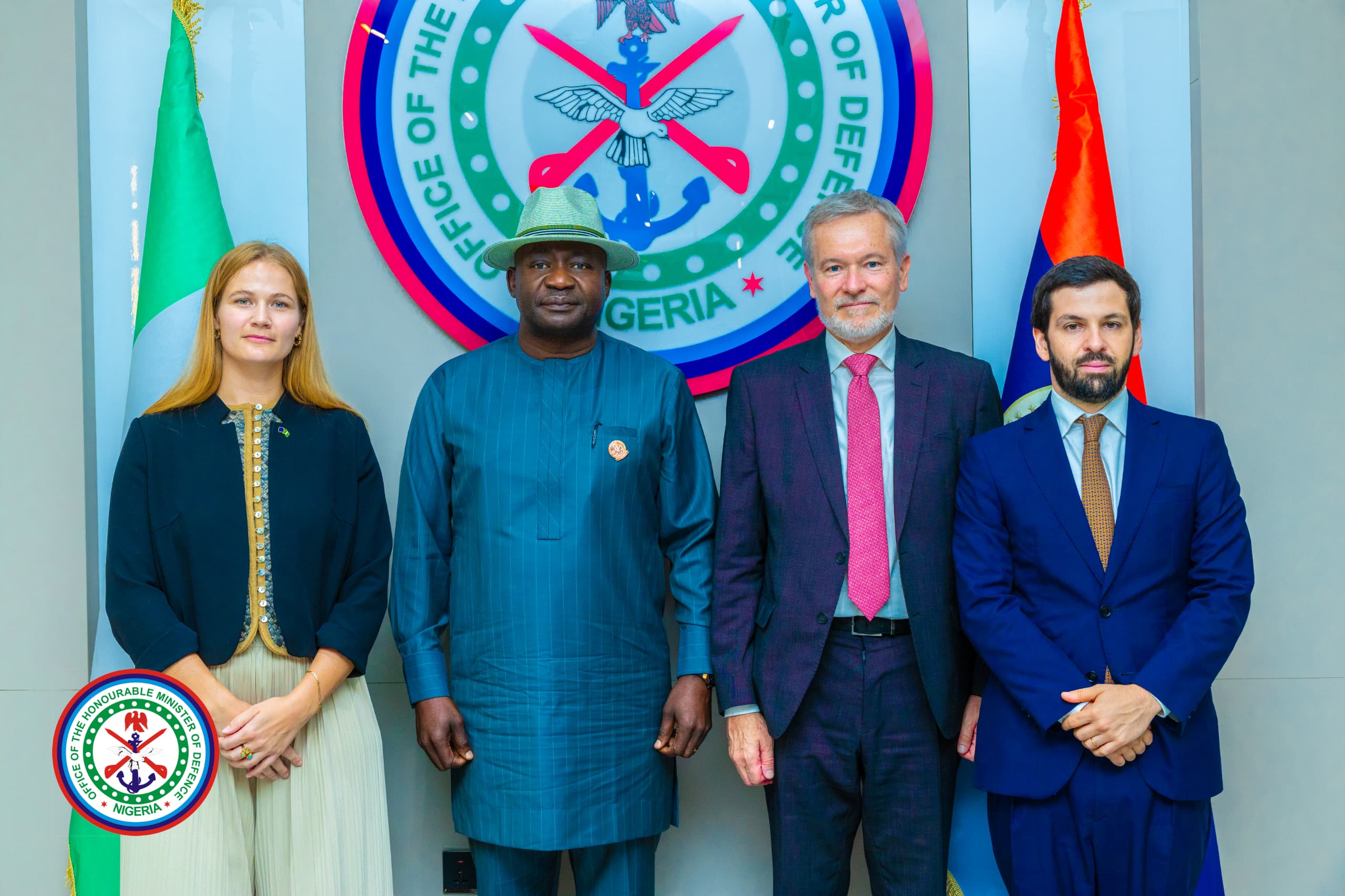
The development was disclosed following a meeting between Nigeria’s Minister of Defence, General Christopher Musa (retd.), and the EU Ambassador to Nigeria and the Economic Community of West African States (ECOWAS), Gautier Mignot, at the Ministry of Defence headquarters, known as Ship House, in Abuja.
Leah Katung-Babatunde, Special Assistant on Media to the Minister of Defence, announced the development in a statement issued on Saturday, October 17, 2026.
According to the statement, the meeting focused on existing bilateral defence agreements, a review of security cooperation and arrangements for the delivery of the €20 million assistance package.
The EU ambassador also disclosed that a technical delegation from the bloc would visit Nigeria in November to discuss and agree on the details of the proposed assistance.
Although the funding represents a significant development in Nigeria’s international defence partnerships, the specific equipment to be supplied, the implementation timetable and the precise breakdown of the funding had not been fully disclosed as of October 18, 2026.
EU Technical Delegation Expected in Nigeria in November
One of the major outcomes of the meeting is the planned visit by an EU technical delegation to Nigeria in November.
The delegation is expected to work with Nigerian authorities to establish the practical arrangements for delivering the €20 million assistance package under the European Peace Facility.
Such technical discussions are important because defence assistance requires decisions on equipment specifications, operational requirements, delivery procedures and how the support will be implemented.
The visit is expected to provide an opportunity for both parties to clarify the needs of the Nigerian Armed Forces and determine how the proposed assistance can best support agreed security priorities.
However, the planned visit does not mean the assistance has already been delivered. The announcement concerns a pledged support package whose implementation details are still being worked out.
The EU has not publicly provided a complete itemised list of equipment or other forms of assistance covered by this particular package in the latest announcement.
The November discussions will therefore be important in determining the practical scope and expected timeline of the programme.
What Is the European Peace Facility?
The European Peace Facility is a financing mechanism established by the European Union to support external action involving peace, security and defence.
It enables the EU to provide assistance to partner countries and regional organisations, including support intended to strengthen their capacity to prevent conflict, respond to security threats and contribute to regional stability.
In Nigeria’s case, the proposed €20 million package forms part of broader engagement between Abuja and Brussels on security cooperation.
Nigeria faces several security challenges, including insurgency in the northeast, attacks on rural communities, kidnapping along major highways, banditry and threats affecting parts of the northwest and north-central regions.
The country also participates in regional security operations aimed at containing armed groups operating around the Lake Chad Basin.
International assistance can complement domestic defence spending by supporting military capabilities, training, equipment and operational cooperation. The precise contribution of the new EU package will depend on the arrangements agreed by both parties.
The proposed assistance should not, however, be interpreted as a guarantee that insecurity will immediately decline. Its impact will depend on how the support is implemented, the capabilities it provides and how effectively those capabilities are integrated into Nigeria’s wider security operations.
Christopher Musa Welcomes European Union Support
During the meeting, Musa expressed appreciation for the European Union’s continued support for Nigeria’s security efforts.
The defence minister reaffirmed the commitment of President Bola Tinubu’s administration to protecting lives, improving security and advancing national development.
Musa said relative peace was gradually returning to some troubled parts of the country through the efforts of the armed forces and other security agencies.
However, he acknowledged that serious challenges remained, particularly kidnapping along major highways and attacks on isolated communities.
These threats continue to affect residents, travellers, farmers, businesses and communities in areas where armed groups operate.
The minister’s remarks highlighted the dual nature of Nigeria’s security situation: military and security operations have been ongoing in several affected areas, but persistent attacks demonstrate that further work is required.
The proposed EU support is expected to contribute to the broader effort to strengthen the Armed Forces of Nigeria, although the precise capabilities to be financed are yet to be fully outlined.
Nigeria Expects 10 Attack Helicopters and Unmanned Aerial Vehicles
During the discussions, Musa also disclosed that Nigeria was expecting the delivery of 10 attack helicopters, unmanned aerial vehicles (UAVs) and other major military equipment to strengthen security operations.
Attack helicopters can support military operations through aerial firepower, rapid response and assistance to ground forces. Unmanned aerial vehicles can provide surveillance and reconnaissance capabilities, depending on their specifications and intended roles.
Such equipment may help security agencies monitor difficult terrain, gather intelligence and respond to threats in areas where conventional ground operations face challenges.
However, the minister did not identify the suppliers or provide a detailed delivery timetable for the helicopters and UAVs in the statement reported on October 17.
It is also important to distinguish these anticipated equipment deliveries from the EU’s €20 million support package. The announcement did not establish that the 10 attack helicopters form part of the European assistance.
The helicopters and UAVs were mentioned as part of Nigeria’s wider military capability requirements, while the EU funding remains subject to technical discussions and final delivery arrangements.
Lake Chad Basin Remains a Major Security Concern
Musa identified the shrinking Lake Chad Basin as a continuing source of instability, noting that the region supports more than 50 million people.
The basin spans areas of several countries, including Nigeria, Chad, Cameroon and Niger. Millions of residents depend on the region for fishing, farming, livestock production and other livelihoods.
Environmental pressures, competition over resources, economic hardship and insecurity have complicated conditions in communities across the basin.
Armed extremist groups have also exploited difficult terrain and local vulnerabilities to establish operational areas, particularly around parts of the Lake Chad region.
Musa said denying terrorists access to holding areas on islands in Lake Chad remained a key operational priority for the Multinational Joint Task Force (MNJTF).
The MNJTF is a regional security arrangement involving countries working together to counter armed groups and address security threats around the basin.
Its operations require cooperation among participating countries, intelligence sharing, coordination and the ability to deploy personnel and equipment in challenging environments.
The minister’s comments underline why Nigeria’s security challenges cannot be addressed exclusively through domestic military action. Cross-border threats require regional coordination and sustained engagement with neighbouring countries.
Nigeria and EU Deepen Their Defence Partnership
The €20 million pledge builds on a broader relationship between Nigeria and the European Union covering peace, security, defence and regional stability.
In February 2026, Nigeria and the EU held their first dedicated Peace, Security and Defence Dialogue in Brussels. The discussions covered counterterrorism, violent extremism, maritime security, cybersecurity, organised crime and disarmament, demobilisation and reintegration.
The dialogue provided a formal platform for both sides to review shared security priorities and identify opportunities for closer cooperation.
According to the European External Action Service, EU peace, security and defence cooperation with Nigeria amounted to more than €700 million between 2015 and 2025. The EU has also supported humanitarian activities and regional security efforts.
The bloc has contributed significantly to the Multinational Joint Task Force, which plays a role in countering armed groups in the Lake Chad Basin.
The new €20 million package therefore forms part of a longer-running relationship rather than an entirely new security partnership.
The November technical visit is expected to move the proposed assistance closer to implementation by clarifying the practical arrangements required for delivery.
Disarmament, Demobilisation and Reintegration Programme Also Discussed
The meeting also addressed Nigeria’s Disarmament, Demobilisation and Reintegration (DDR) programme.
DDR initiatives are designed to support processes through which eligible former members of armed groups disarm, leave armed organisations and work towards reintegration into civilian life.
Such programmes can form part of broader efforts to stabilise communities affected by conflict. Their effectiveness depends on appropriate screening, security arrangements, rehabilitation, community participation and measures to reduce the risk of renewed violence.
Musa stressed that the programme should prioritise victims of conflict, including military personnel affected by the fighting.
His remarks drew attention to the human consequences of prolonged insecurity, which extend beyond battlefield casualties to include displacement, family separation, economic disruption and the psychological effects of violence.
While military operations remain a central component of Nigeria’s response to armed groups, rehabilitation and reintegration initiatives can also contribute to longer-term stability when appropriately designed and implemented.
The discussion suggests that the Nigeria-EU relationship encompasses more than equipment and operational support. It also includes wider questions about recovery, peacebuilding and the effects of conflict on affected populations.
What the €20 Million Pledge Means for Nigeria
The proposed assistance offers Nigeria an additional opportunity to strengthen its defence relationship with a major international partner.
Its practical value will depend on the final package, including the equipment or services selected, the delivery schedule and how the assistance complements existing Nigerian military capabilities.
The funding may also create opportunities for closer technical cooperation between Nigerian defence institutions and European partners.
Nevertheless, several questions remain unanswered. The latest announcement does not provide a detailed breakdown of the €20 million, identify every item to be supplied or confirm a final handover date.
The planned technical delegation in November is expected to help clarify these matters.
For communities affected by insecurity, the central concern will be whether improved military capabilities translate into better protection, fewer attacks, safer roads and more reliable access to farms, schools and markets.
Equipment and international partnerships can support those objectives, but sustained progress also depends on effective intelligence gathering, coordination among security agencies, accountability and the ability to protect civilians.
Conclusion: The European Union’s €20 million defence pledge represents another step in security cooperation between Nigeria and its European partners. With technical discussions expected in November, the next stage will focus on determining how the assistance will be delivered and what capabilities it will support. For Nigeria, the ultimate test will be whether the cooperation contributes to stronger security operations and improved protection for communities facing persistent threats.
About the Author